
REVIEW · CYCLING TOURS
Paris: Guided bike tour – Greatest monuments of the capital
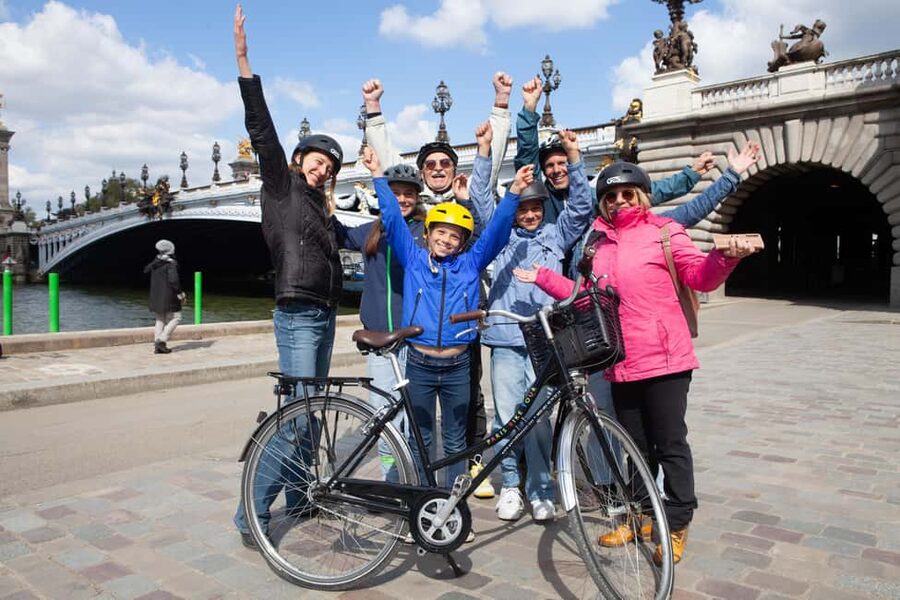
Paris makes more sense from a bicycle. This three-hour ride links the Seine, Notre-Dame, the Louvre, and the Eiffel Tower without burying you in a bus or Metro tunnel. I like the excellent monument coverage and the guide-led stories that connect royal Paris with modern city life. I also like the short stops, which give you time to look, take photos, and catch your breath.
The main caution is the cycling itself. You need good bike skills, and one rider found the bikes best suited to people with strong grip and above-average riding experience. Children must be at least 12, so this is not a casual family pedal for younger kids.
In This Review
- Key points before you book
- Why a bicycle works so well in central Paris
- Starting near Centre Pompidou and Le Marais
- Crossing the islands to Notre-Dame
- The Conciergerie and the story of Marie Antoinette
- From the Seine to Place de la Concorde
- Tuileries Garden and the Louvre
- Grand Palais and the western riverfront
- Trocadéro, Chaillot, and the Eiffel Tower view
- Musée du Quai Branly and the return route
- How demanding is the cycling?
- The guide makes the difference
- Is $51 a fair price?
- Who should book this bike tour?
- Should you book it?
- FAQ
- Where does the Paris bike tour start?
- How long does the tour last?
- What languages are available?
- What equipment is included?
- Is the tour suitable for children?
- Can I cancel the booking?
Key points before you book
- Three hours beside the Seine: The route packs in Paris icons while keeping the river as your main thread.
- Starts near Centre Pompidou: Meet at 13, rue Brantôme, just two minutes from Rambuteau Metro station.
- A guide does the connecting work: You hear the stories behind the Conciergerie, Notre-Dame, royal squares, bridges, and major museums as you ride.
- Stops are short but useful: Several pauses last about 10 minutes, enough for photos and orientation rather than full museum visits.
- Good gear is supplied: You receive a city bike, helmet, basket, rain poncho, and child seat up to 25 kilograms.
- A strong value at $51: You cover a large slice of central Paris with a live guide, rather than paying for separate sightseeing rides and orientation.
Why a bicycle works so well in central Paris
Paris is compact on a map, but its major sights do not all sit in one tidy cluster. The Louvre, Notre-Dame, the Eiffel Tower, Tuileries Garden, and Place du Trocadéro are linked by the Seine, yet walking between them can eat up much of a day.
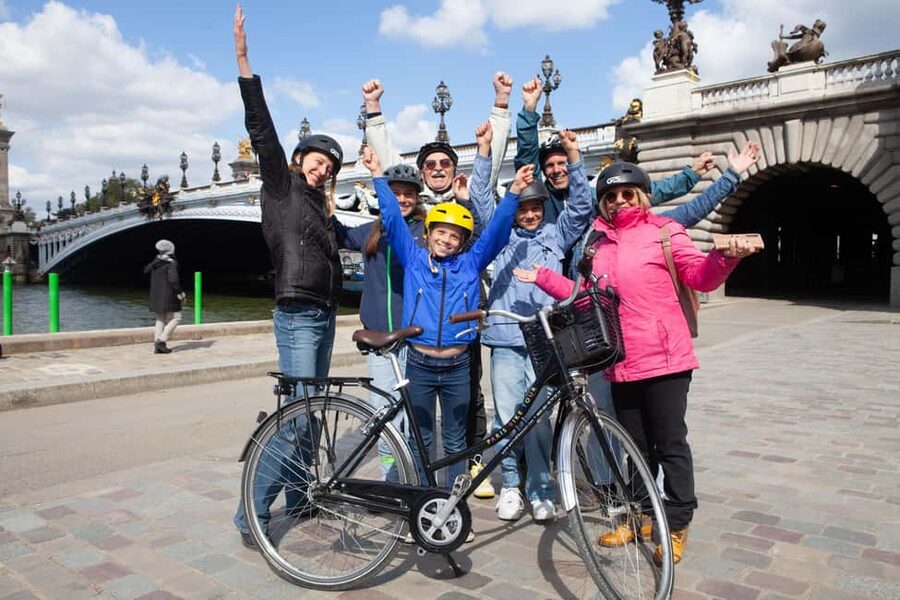
A bicycle changes the pace. You move farther than you would on foot, but you remain close enough to see bridges, façades, riverbanks, and passing streets. I like that balance. You are not sealed behind glass, and you do not spend the whole outing trying to find the next Metro entrance.
This tour is also a useful first look at Paris. You will not enter the Louvre, climb the Eiffel Tower, or tour Notre-Dame’s interior during this ride. Instead, you get a city-wide introduction, with a guide helping you decide which sights deserve more of your time later.
The route lasts three hours, so expect a steady sightseeing ride rather than a long café stop or a slow neighborhood wander. The schedule includes several brief pauses of about 10 minutes, plus a five-minute stop near Chaillot. That keeps the tour moving, though anyone hoping for extended time at every monument may find the stops too short.
More Cycling Tours in Paris
- Versailles Palace Bike Tour with Market & Marie-Antoinette hamlet
★ 5.0 · 2,680 reviews - Paris: Charming Nooks and Crannies Bike Tour
★ 4.8 · 2,585 reviews - From Paris: Versailles Bike Tour w/ Palace, Gardens, & Picnic
★ 5.0 · 2,150 reviews
Starting near Centre Pompidou and Le Marais
You meet at the local operator’s office at 13, rue Brantôme, in the 3rd arrondissement. The office is close to the Centre Pompidou, and Rambuteau Metro station is about a two-minute walk away. That makes the starting point fairly easy to reach from other parts of Paris.
The ride begins in or near Le Marais, one of the city’s most rewarding central districts. Here, the value is less about checking off a single monument and more about getting a feel for old Paris streets before reaching the river.
Your guide handles the opening orientation and leads the group toward the Seine. The supplied bike includes a basket, which is handy for a small water bottle or light personal items. A helmet is included, and a rain poncho is available if the weather turns wet.
You should arrive in comfortable shoes and clothing suited to the forecast. Bring water. The tour does not include food or drinks, and three hours on a bicycle can feel longer than three hours of walking if you arrive unprepared.
Crossing the islands to Notre-Dame
One of the best parts of the route is the move across Paris’s river islands. From the right bank, you get views toward the Conciergerie and Île Saint-Louis before crossing toward Île de la Cité.
The bridges are not just practical crossings. They give you changing angles on the Seine and show how central Paris developed around its river. Your guide can turn what might otherwise be a quick pedal into a sequence of short history lessons about the city and its bridges.
Notre-Dame Cathedral is a major pause point. Even with restoration work following the 2019 fire, the cathedral remains one of Paris’s defining sights. The tour lets you appreciate its position on Île de la Cité and see it as part of the city’s wider river setting.
Do not expect an interior visit here. The value is the approach, the exterior view, and the context supplied by the guide. If Notre-Dame is a top priority for you, use this stop to get oriented, then plan separate time for current visiting arrangements.
The route also reaches Île Saint-Louis. This smaller island offers another perspective on the historic center and helps you see how close many of Paris’s major sights are to one another. You will not spend a long time wandering its streets, but the crossing adds variety to the ride.
The Conciergerie and the story of Marie Antoinette
The Conciergerie is among the most memorable stops because it connects the medieval city with the French Revolution. The former royal palace later became a prison, and Marie Antoinette spent her final days there.
From a bicycle, you mainly see the exterior and hear the story. That is enough to give the building a sharper meaning than a quick photograph from a passing bus. I appreciate this kind of stop because the guide supplies the human detail while you remain in the flow of the city.
The Conciergerie appears more than once in the route’s visual story, first in the opening views and again as the tour works through the central monuments. That repetition reflects its location beside the river and its importance to the historic core.
More bike routes around Paris:
- Paris: City Highlights Bike Tour
★ 4.7 · 1,835 reviews - Electric Bike Tour of Paris’ Hidden Gems
★ 4.9 · 1,377 reviews - Paris Local Districts and Stories Off the Beaten Track Guided Bike Tour
★ 5.0 · 1,264 reviews - Best of Paris Electric Bike Tour
★ 5.0 · 1,179 reviews
From the Seine to Place de la Concorde
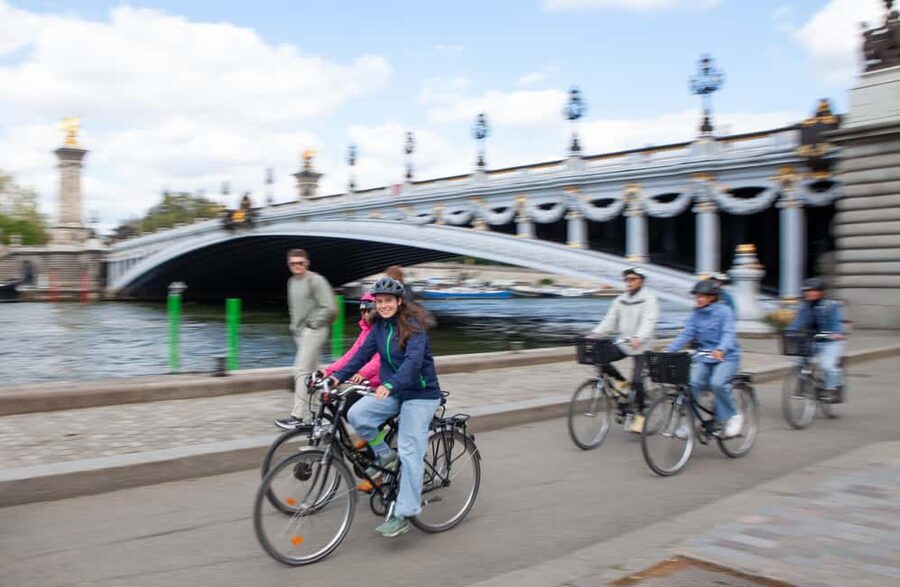
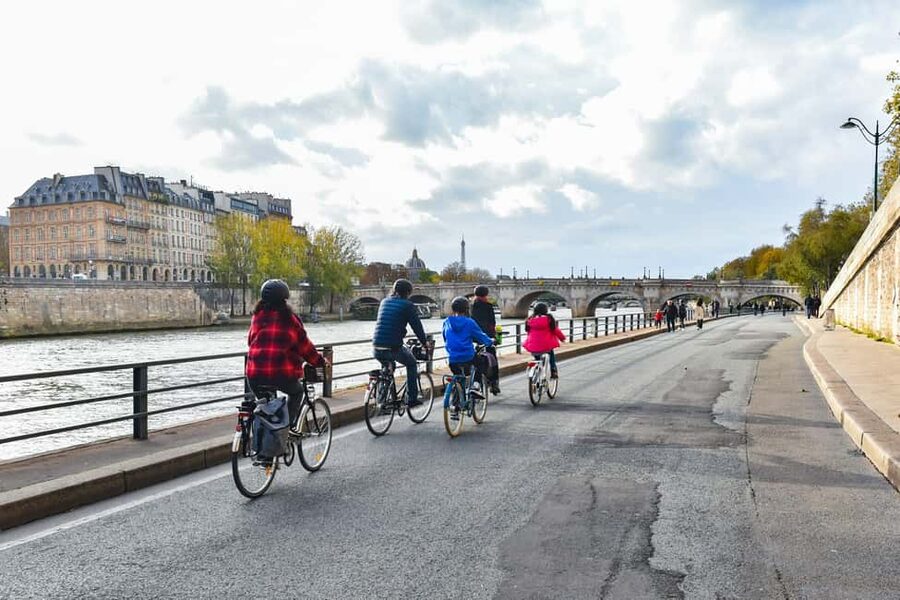
The Seine remains your main guide as you move west. Along the way, the route presents Paris as a sequence of grand public spaces, monumental buildings, bridges, and formal gardens.
Place de la Concorde receives a roughly 10-minute stop. It is the largest royal square in Paris, and its scale is easier to understand from a bicycle than from a tightly packed walking route. You can take in the open space, hear the political and royal background, and continue before the stop becomes a full history lecture.
This is also a useful point to notice how Paris changes from medieval island streets to broad, carefully planned avenues and squares. You get a visual lesson in the city’s layers without needing a separate architecture tour.
Tuileries Garden and the Louvre
The next major section brings you through the Tuileries Garden and toward the Louvre. The gardens provide a welcome change from streets and bridges, with open paths and formal design leading toward one of Europe’s most famous museums.
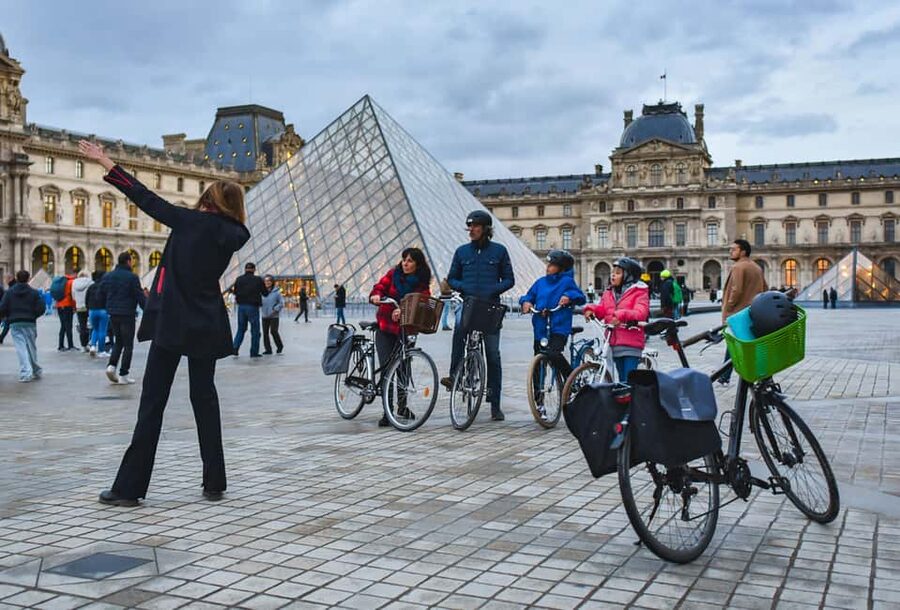
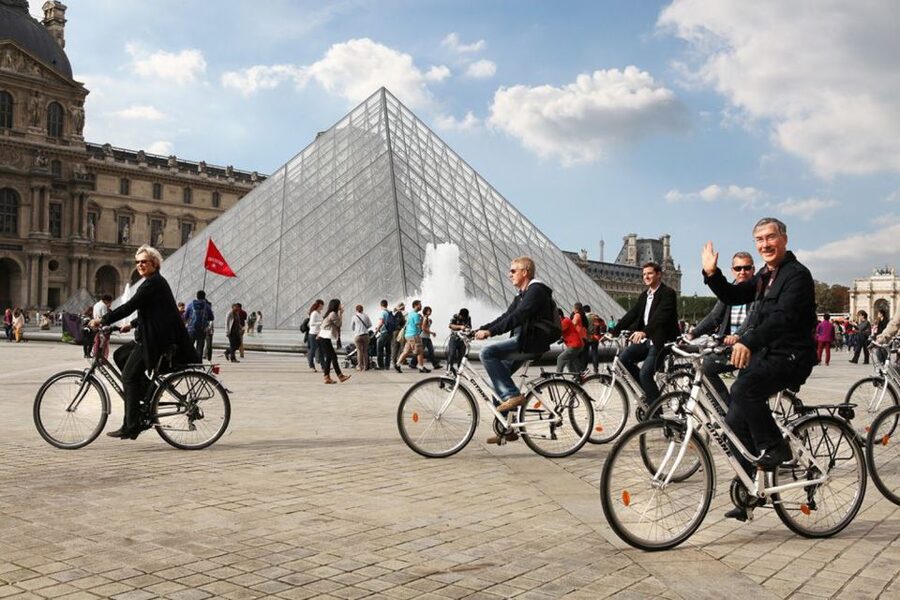
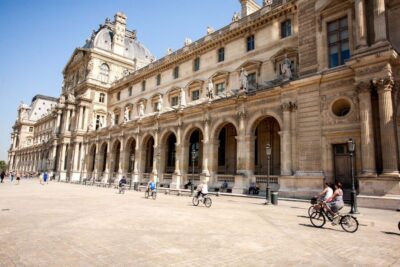
The tour does not include Louvre admission. You see the exterior and its setting, including the relationship between the palace, garden, and river. That is a good use of a short bike stop because a full Louvre visit can easily consume half a day or more on its own.
I like the way this part puts the museum in context. The Louvre is not simply a giant building packed with art. Its long connection with royal Paris becomes clearer when you approach it from the Tuileries and Place de la Concorde.
The itinerary allows about 10 minutes at the Tuileries. That is enough for a quick look and photographs, but not enough for a leisurely stroll through the whole garden. If you want quiet garden time, plan to return later.
Grand Palais and the western riverfront
The ride continues toward the Grand Palais, another short stop of about 10 minutes. The building is recognizable for its large glass roof and grand exhibition architecture, though the tour focuses on sightseeing rather than entry.
This section helps break up the better-known sights. Many first-time visitors aim straight for the Eiffel Tower and Louvre, but the Grand Palais gives you another piece of Paris’s public and cultural identity.
You also continue seeing the Seine from new angles. The riverbanks have UNESCO World Heritage status, and the bike route uses that setting well. You are not simply traveling between monuments. You are following the historic spine that makes the monuments feel connected.
Trocadéro, Chaillot, and the Eiffel Tower view
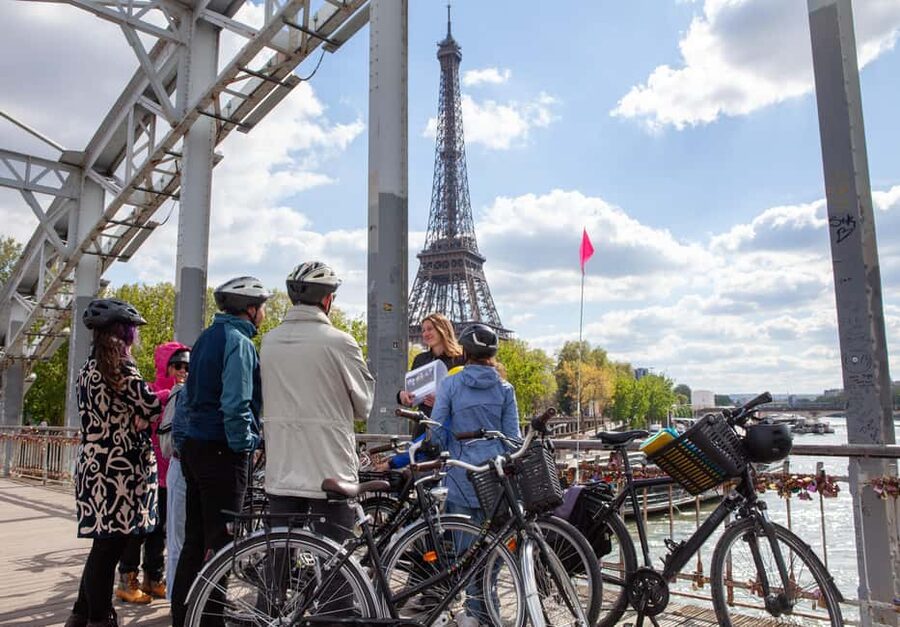
The route’s big photo moment arrives at Place du Trocadéro. The scheduled stop lasts about 10 minutes, giving you time to frame the Eiffel Tower and take the classic view across the river.
This is one of the clearest reasons to choose the bicycle tour over a standard walking route. The Eiffel Tower is not close to the Louvre or Notre-Dame on foot, but the bike makes the connection practical within one outing.
Near Chaillot, you get another short stop, listed at about five minutes. The Chaillot area provides important views toward the tower and the Seine, while the nearby palace architecture adds scale to the scene.
The Eiffel Tower itself receives about 10 minutes. Again, this is an exterior sightseeing stop, not a tower entry. You will have time for photographs, a quick look around, and the guide’s explanation, but you will not ride up the tower or wait in a lift line.
A short pause here also gives you a chance to rest. One rider noted that the bikes were decent but worked best with shoes offering very good grip. That is practical advice. Paris cycling requires attention, and the right footwear can make the ride feel more secure.
Musée du Quai Branly and the return route
The Musée du Quai Branly appears on the western section of the route, with a short stop of about 10 minutes. The green wall is a distinctive feature and gives the ride a splash of plant-covered modern design among the grand stone monuments.
You will not tour the museum collections. The stop is about the building and the visual setting, adding a contemporary note to a route otherwise packed with royal squares, cathedrals, palaces, and older streets.
From here, the tour turns back toward the central islands and the starting point. The return route allows you to see familiar monuments from different angles. That matters in Paris, where a building can look completely different from the river, a bridge, or a nearby square.
The activity ends back at 13, rue Brantôme. Since the start and finish are at the same office, you do not need to arrange a second pickup point or work out where to leave the group.
How demanding is the cycling?
The operator requires good cycling skills, and you should take that seriously. This is not described as a gentle beginner lesson, and the route includes city riding, bridges, and a full three hours in the saddle.
One rider with more than 20 years of occasional cycling experience, much of it on mountain bikes, still advised caution about bringing children. That rider felt reasonably safe but found that the bikes called for strong grip and above-average riding ability.
The tour is officially suitable for children aged 12 and over. A child seat is included for a child up to 25 kilograms, but the age guidance and cycling warning should both shape your decision. The seat does not make the tour suitable for younger children if the adult rider is not fully comfortable in city traffic.
You receive a city bike, helmet, basket, and rain poncho. The equipment covers the basics, but it does not remove the need for confidence. If you rarely ride, feel unstable when turning, or dislike cycling in an urban setting, a walking tour may be a better fit.
The guide makes the difference
The guide is central to the value. You are not just following a marked route and taking photos. You hear why the Conciergerie matters, how the islands fit into Paris, and how the Louvre, Tuileries, Concorde, and Eiffel Tower relate to one another.
The tour operates in English or French. A recent outing with a guide named Felix was praised for his friendly manner and willingness to answer questions. He was also open about the limits of his knowledge when faced with obscure questions, which is preferable to a guide inventing an answer.
Another strong point is the relaxed pace. The route covers a lot, but the timing is arranged so that it does not feel like a race from one monument to the next. That combination of broad coverage and manageable pauses is a major reason the tour earns a 4.9 rating from 28 ratings.
Guide quality can vary from one departure to another, but the format gives you a real person to ask. You can also ask for practical Paris tips when you return to the office, which is useful early in a stay.
Is $51 a fair price?
At $51 per person, the tour is good value if you want a broad first look at central Paris. The price includes the guide, city bike, helmet, basket, rain poncho, and child seat. Food and drinks are extra, but no meal is promised, so that is not an unexpected gap.
The value comes from the distance covered and the time saved. You see the Seine, Notre-Dame, Île de la Cité, Île Saint-Louis, Conciergerie, Place de la Concorde, Tuileries, Louvre, Grand Palais, Trocadéro, Chaillot, Musée du Quai Branly, and Eiffel Tower in three hours.
You are paying for orientation, transport between sights, and interpretation rather than admission tickets. If you already know Paris well or want long visits inside museums, this may feel limited. If you are arriving for a short stay and want to understand the city’s layout quickly, the price makes good sense.
Free cancellation up to 24 hours before the tour and the option to reserve now and pay later add flexibility. Check the available departure times before booking, since the start schedule is not fixed in the information provided.
Who should book this bike tour?
I would choose this for an active first day in Paris, especially if you want to see many headline sights before deciding where to return. It suits adults and confident cyclists aged 12 and over who enjoy outdoor sightseeing and do not need to enter every monument.
It is also a good match for anyone who finds long walking days tiring but still wants to stay close to the city. The bicycle reduces the distance between attractions while keeping the river, bridges, and streets in view.
I would be cautious if you are a nervous cyclist, have limited riding experience, or are planning this with young children. The short photo stops may also disappoint you if you want to spend substantial time inside the Louvre, Notre-Dame, or Eiffel Tower.
Should you book it?
Book this tour if you want a fast, useful introduction to Paris with a live guide and a strong list of landmarks. The route is especially worthwhile early in your stay, when you need a mental map of the Seine and the central sights.
Skip it if cycling feels stressful or if your main goal is interior visits. For confident riders, though, $51 buys three hours of city orientation, striking river views, and a practical way to connect places that are spread across central Paris.
FAQ
Where does the Paris bike tour start?
It starts at the local tour operator’s office at 13, rue Brantôme, 75003 Paris. The office is about a two-minute walk from Rambuteau Metro station and close to Centre Pompidou.
How long does the tour last?
The guided bike tour lasts three hours. Departure times vary, so check availability when choosing a date.
What languages are available?
The live guide is available in English or French.
What equipment is included?
The tour includes a city bike, helmet, basket, rain poncho, and child seat. The child seat has a maximum weight limit of 25 kilograms.
Is the tour suitable for children?
The tour is suitable for children aged 12 and over. Good cycling skills are required, and the child seat limit is 25 kilograms.
Can I cancel the booking?
You can cancel up to 24 hours in advance for a full refund. You can also reserve now and pay later.
Recently added in Paris
- Private Transfers in Paris★ 5.0 · 75 reviews
- CDG – Euro Disney – CDG Two Way Private Shuttle Transfer★ 5.0 · 233 reviews
- Disneyland® Paris 1 Day Ticket with Transport from Paris★ 3.5 · 302 reviews
- Personalized Transport service from Disneyland to Paris★ 5.0 · 63 reviews
- Monet’s Gardens & House-Private Giverny Tour From Paris★ 4.5 · 137 reviews
- Guided tour Monet’s house and gardens/small group★ 4.5 · 68 reviews
- Giverny Monet House and Gardens Skip the line Walking tour★ 4.0 · 217 reviews
- Monet’s House and Garden & Giverny Village★ 4.5 · 39 reviews
Cycling Tours, compared.
Versailles Palace Bike Tour with Market & Marie-Antoinette hamlet
Read our review →
Versailles Bike Tour w/ Palace, Gardens, & Picnic
Read our review →
Paris Local Districts and Stories Off the Beaten Track Guided Bike Tour
Read our review →
Highlights of Paris Bike Tour w/ a Local Guide (English or Dutch)
Read our review →Browse the lists this tour appears in