
REVIEW · LOUVRE MUSEUM TOURS
Paris: Louvre Masterpieces Tour with Pre-Reserved Tickets
The Louvre is too big for guesswork. This two-hour tour makes the museum manageable with reserved priority entry and a group capped at six people. I like the efficient route through major works, and I like having an expert guide explain what you are seeing instead of simply pointing toward famous paintings. The main caution is that priority entry does not remove the security check, which can still take time.
The small-group format also matters inside crowded galleries. Guides such as Jerome, Matteo, Iason, Ashkan, and Maryam have been praised for making art lively, answering questions, and keeping children involved. You cannot join after the tour begins, and timed tickets may expire within five to ten minutes, so arriving early is essential.
In This Review
- Key points to know before booking
- Why a guide helps inside the Louvre
- Meeting at Café Le Nemours
- Entering beneath the Louvre Pyramid
- The Louvre’s essential masterpieces in two hours
- Mona Lisa, Venus de Milo, and Winged Victory
- Renaissance painting and Michelangelo’s Slaves
- French Romanticism and the drama of history
- Sculpture, architecture, and the quieter rooms
- What the small group changes
- Price and value at $152
- Practical limits you should know
- Who should book this Louvre tour?
- FAQ
- How long is the Louvre masterpieces tour?
- Where does the tour meet?
- How will I recognize the guide?
- Is Louvre admission included?
- Does the tour completely avoid lines?
- What languages are available?
- Can I stay inside the Louvre after the tour?
- What should I bring?
- Can I bring luggage or a large bag?
Key points to know before booking
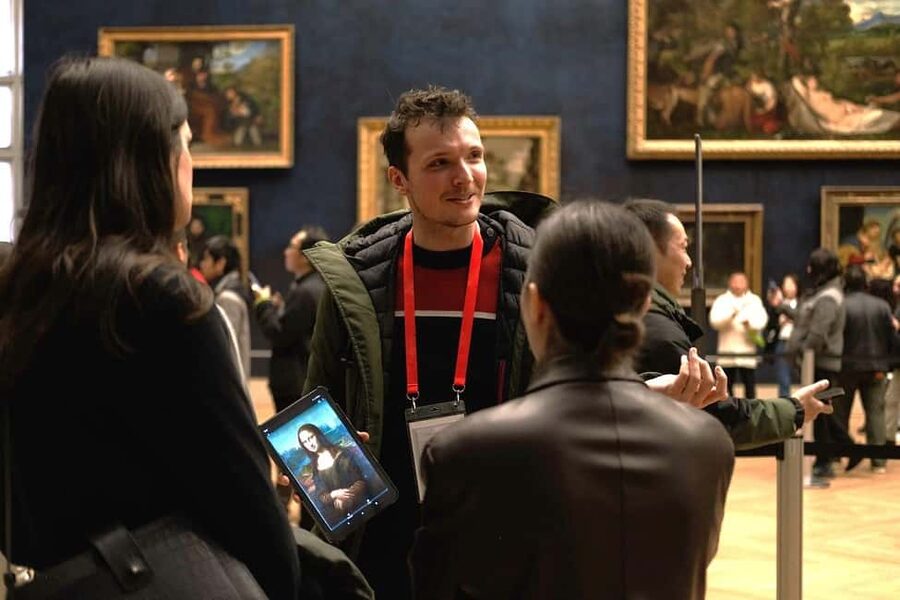
- Six-person maximum: The smaller group gives you a better chance to hear the guide and ask questions without shouting across a gallery.
- Reserved Louvre entry: You avoid the regular ticket queue, though everyone still passes through security.
- Two-hour masterpieces route: The itinerary focuses on famous works across several departments rather than attempting the whole museum.
- Stay after the tour: Your ticket lets you continue exploring inside the Louvre at your own pace.
- Meeting point by Palais Royal: Meet outside Café Le Nemours, near metro exit 5, Place Colette.
- English or German guides: Private and small-group formats are available, depending on the booking option.
Why a guide helps inside the Louvre
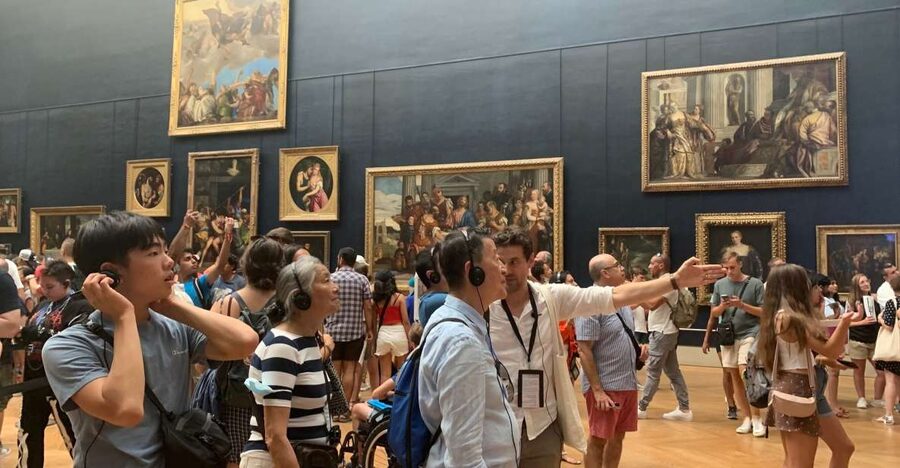
The Louvre is not just a large museum. It is a former royal palace with galleries spread across eight departments and a collection of about 35,000 artworks. That scale can turn a first visit into a march from one famous name to another, with little sense of how the pieces fit together.
This tour gives you a framework. Instead of wandering until you find the Mona Lisa, you follow a route that connects Italian Renaissance painting, French Romanticism, neoclassical sculpture, and the museum’s grand architectural spaces.
That structure is the tour’s main value. You are not paying only for a ticket. You are paying for orientation, time saved, and explanations that help you look at the art with more confidence.
The guide is especially useful for works that seem familiar from books or screens. The Mona Lisa, for example, is often reduced to a quick photograph in a packed room. A good explanation gives you a reason to look beyond the famous smile and notice details of composition, technique, and reputation.
The small group makes that teaching easier. With six people or fewer, the guide can respond to questions and adjust the pace. Several past departures have ended up with only two participants when others did not arrive, creating an especially personal visit. That is not guaranteed, but the six-person limit gives the tour a more private feel than a large museum walk.
More Louvre visits and guided rooms:
- Paris: Louvre Museum Timed-Entrance Ticket
★ 4.6 · 71,977 reviews - Paris: Louvre Guided Tour with Reserved Access & Boat Cruise
★ 4.3 · 16,353 reviews - Louvre Museum Masterpieces Guided Tour with Access
★ 4.5 · 12,023 reviews
Meeting at Café Le Nemours
The tour begins outside Café Le Nemours, a traditional meeting point near the Louvre and Palais Royal. Your guide holds a sign marked Walks In Europe.
The nearest metro stop is Palais Royal. Use exit 5, Place Colette. When you come out, turn around and Café Le Nemours should be visible. This is a simple meeting point, but Paris traffic and metro delays can work against you, so leave extra time.
The timing is important here. The Louvre tickets are timed, and they can expire within five to ten minutes. Once the tour starts, it is not possible to join late. One past booking involved a late arrival connected with major city festivities, and the guide sent tickets by phone, but you should treat that as a fortunate exception, not a plan.
Bring a valid passport or identity card. Security and monument checks may require it.
Entering beneath the Louvre Pyramid
The glass Pyramid is passed on the way to the museum rather than treated as a separate stop. Still, it is an important part of the arrival. The Pyramid gives you a clear visual marker and leads into one of the world’s most famous museum entrances.
The reserved ticket helps you avoid the standard ticket line. That can be a major advantage during busy periods, when the regular queue may stretch a long way. But skip the line does not mean skip security. Every person must pass through the museum’s security check, and that line may still be long in high season.
Large bags, luggage, umbrellas, and mobility scooters are not allowed. Pack lightly. A small day bag is more practical than arriving with shopping or heavy belongings.
Once inside, your guide takes over the navigation. That is where the tour earns its keep. The Louvre’s corridors can feel like a maze, and moving efficiently between departments is not obvious on a first visit.
The Louvre’s essential masterpieces in two hours
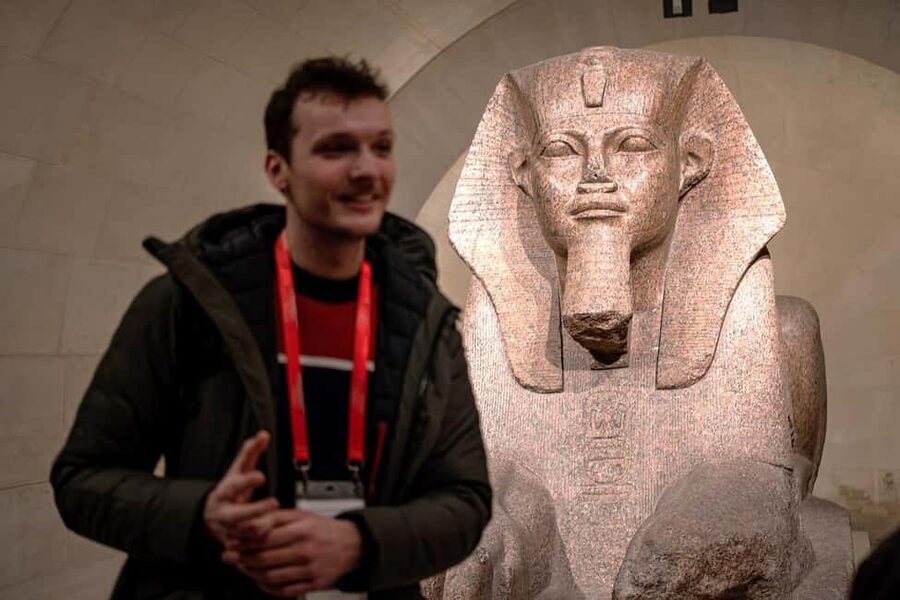
Two hours is long enough for a strong introduction, but not long enough to see everything. The route concentrates on major works and uses them to explain broader periods of art and French history.
Expect to see the following highlights, though the exact order can change:
- Mona Lisa
- Venus de Milo
- Winged Victory of Samothrace
- Wedding Feast at Cana
- Michelangelo’s Slaves
- The Raft of the Medusa
- Liberty Leading the People
- The Coronation of Napoleon
- Psyche Revived by Cupid’s Kiss
- The Caryatids
- Salon Carré
That is an ambitious list for two hours. The benefit is range. You move from ancient sculpture to Renaissance painting, from political drama to neoclassical elegance. The drawback is that most works receive an introduction rather than a long, quiet study.
If you want to spend 30 minutes with one painting, this is not the right format. If you want to understand what matters and then return to your favorites afterward, it works far better.
A few more Paris outings to set side by side
- Disneyland® Paris 1-Day Ticket
★ 4.6 · 49,412 reviews - Paris: Versailles Palace and Gardens Full Access Ticket
★ 4.6 · 41,579 reviews - Paris: Evening River Cruise with Music
★ 4.4 · 22,721 reviews - Paris: Eiffel Tower Entry Ticket with Optional Summit Access
★ 4.4 · 20,035 reviews
Mona Lisa, Venus de Milo, and Winged Victory
The Mona Lisa is the obvious target, and the tour makes sure it is part of the route. Crowds can be thick around the painting, especially during peak hours. Your guide helps you find the work and explains how to approach the room, but no tour can promise an empty gallery or unlimited time directly in front of the painting.
The Venus de Milo offers a different kind of encounter. This ancient sculpture is a chance to consider how later audiences shaped the idea of classical beauty. The guide can provide the context that a short glance alone cannot.
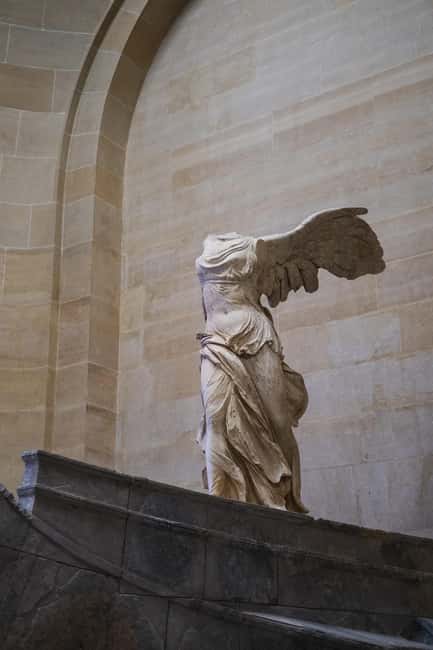
Winged Victory of Samothrace is one of the Louvre’s most dramatic displays. Its elevated position on the Daru staircase gives the sculpture a sense of movement and arrival. Even when the gallery is crowded, the setting helps explain why this work has such force.
These three icons are the visual anchors of the tour. They are also the places where crowds and photography can slow you down. Keep your expectations realistic: the priority is seeing the works and understanding them, not having a private gallery.
Renaissance painting and Michelangelo’s Slaves
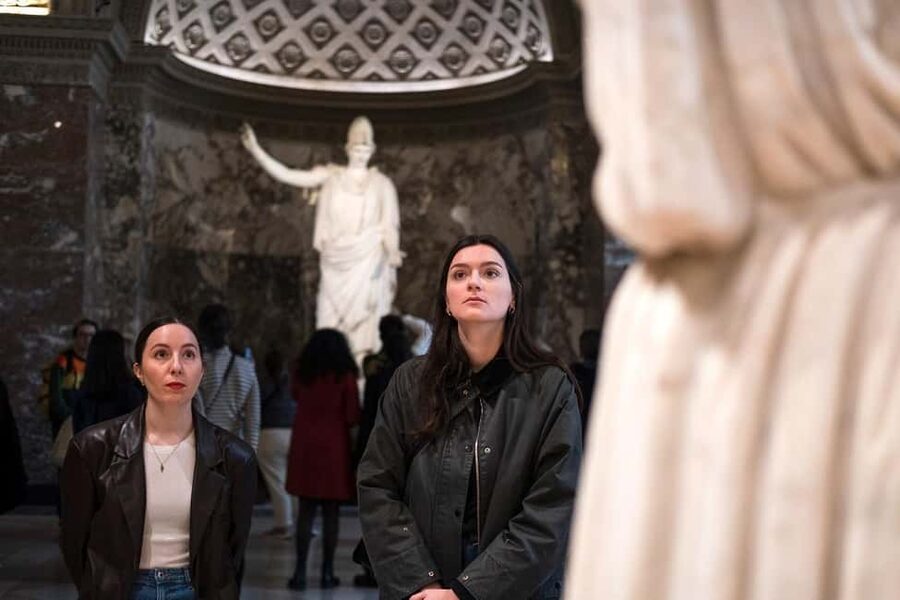
The Italian Renaissance section brings a change in mood and scale. The Wedding Feast at Cana is enormous, detailed, and easy to overlook if you are focused only on the Mona Lisa. A guide can point out the layers of action and the visual choices that make the painting worth more than a quick pass.
Michelangelo’s Slaves provide a useful contrast. The unfinished surfaces invite questions about process, intention, and the way a sculpture can appear to emerge from stone. This is the sort of work that benefits from a trained guide, because the roughness is not simply a lack of completion. It is part of the conversation.
The strongest guides make these stops feel connected. You learn how artists used bodies, gestures, space, and symbolism to communicate. That lesson can help you read other works in the museum after the tour ends.
French Romanticism and the drama of history
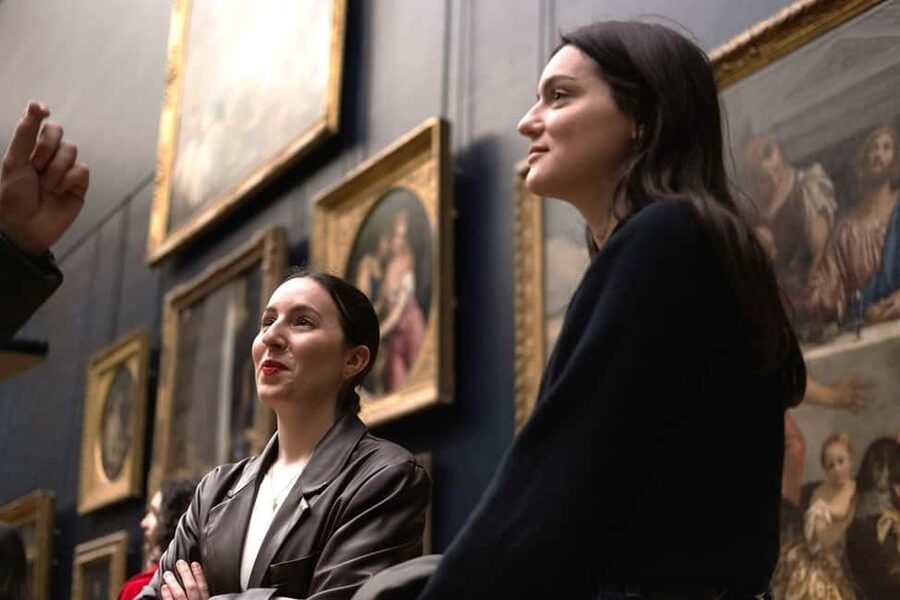
The French paintings bring the tour into a more political and emotional register. The Raft of the Medusa is difficult to miss because of its scale and drama. The painting depicts desperation, survival, and the consequences of a national scandal. A short explanation gives you a better sense of why it mattered in its own time.
Liberty Leading the People adds revolution, symbolism, and public identity. Even if you have seen reproductions, the original’s size and color make a stronger impression in person.
The Coronation of Napoleon shifts the focus toward power and official image-making. This is a useful stop for understanding how art served rulers and governments. The guide can help you separate the event being shown from the message the painting wants you to accept.
This part of the route is particularly good for anyone who wants French history explained through art. Several people who had little formal background in French history found this approach helpful, and that makes sense: the paintings give you people, conflict, ambition, and consequence rather than a list of dates.
Sculpture, architecture, and the quieter rooms
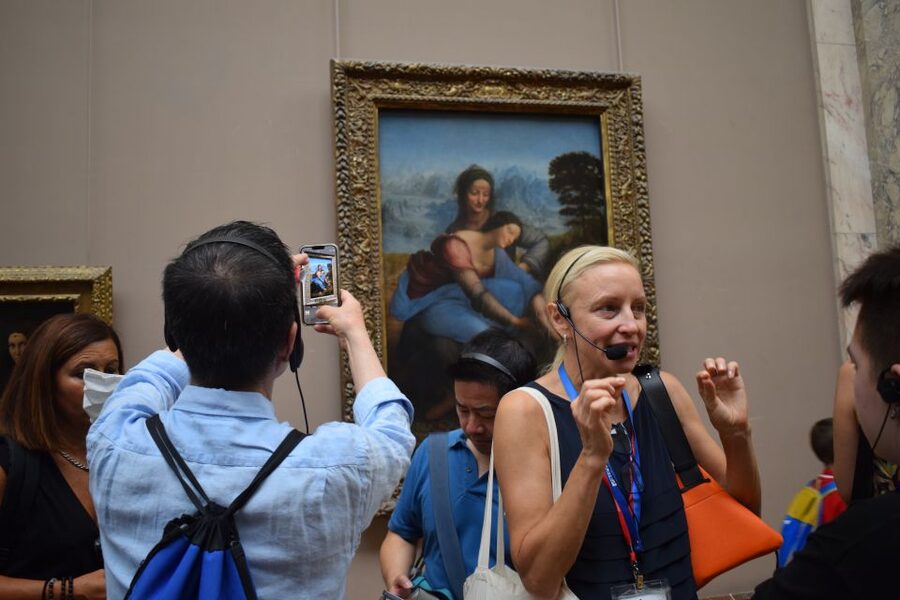
Psyche Revived by Cupid’s Kiss offers a more intimate counterpoint to the large history paintings. Its neoclassical beauty is polished and theatrical, but it also rewards a close look at the figures and their physical connection.
The Caryatids bring your attention to the building itself. The Louvre is not just a container for art. Its rooms, staircases, ceilings, and decorative details are part of the visit. A guide who includes the architecture helps you understand why moving through the museum can feel like moving through several eras at once.
The Salon Carré provides another change of pace. Its refined proportions and decorative setting show how the museum’s rooms were designed to frame art, not merely store it. This is one reason a guided route can feel more satisfying than a checklist of famous objects. You see paintings, but you also begin to understand the palace around them.
What the small group changes
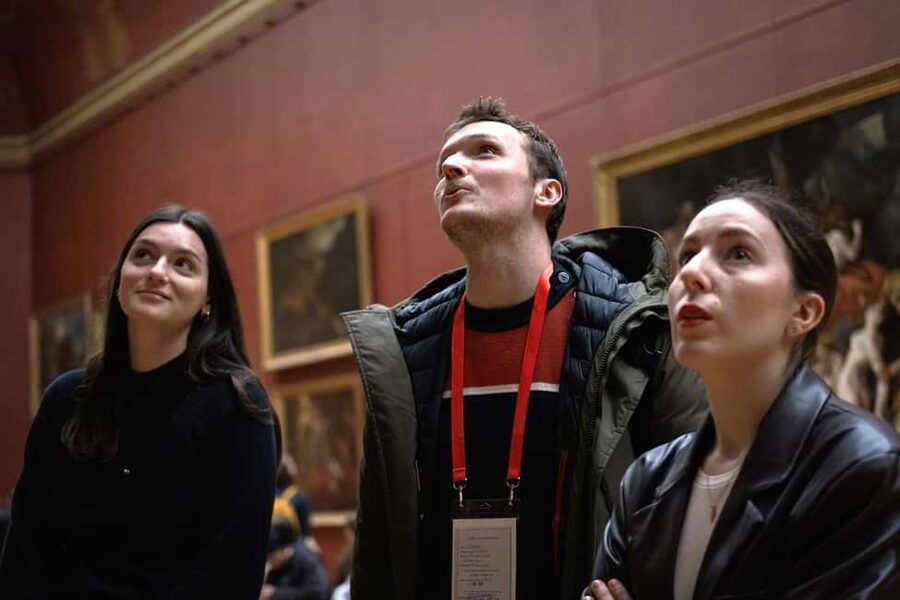
A group of six is a sensible compromise between a private tour and a standard shared visit. You pay more than you would for simple museum admission, but you gain a guide who can speak at a normal volume and notice when someone has a question.
Parents may find the format especially useful. Guides including Matteo and Iason have been praised for using humor, stories, and questions to keep children around ages 10 and 11 engaged. That does not make the Louvre a children’s museum, but it can prevent the visit from becoming two hours of tired faces and hurried footsteps.
The format also helps if you have a particular interest. One guide adjusted the route to include a requested painting, while another suggested Napoleon’s apartments, which were described as a quieter area to explore afterward. Ask politely, but understand that special requests depend on time, museum conditions, and the guide’s route.
If the booking attracts more than six people, the group may be divided among guides at the meeting point. That preserves the six-person limit within each group, though your party may not all remain with one guide.
Price and value at $152
At $152 per person, this is not a budget Louvre visit. The value depends on how much you want guidance and how precious your Paris time is.
I think the price is easier to justify if this is your first Louvre visit, you have only a few days in Paris, or you feel uneasy navigating a huge museum. Reserved admission can save a long wait, and the guide helps you cover major works without losing time in the corridors.
The included ticket also lets you remain in the museum after the two-hour tour. This is important. You can use the guided visit to get oriented, then return to rooms that caught your attention. That extra time makes the package more useful than a tour that ends at the exit.
The price is harder to justify if you already know the Louvre well, prefer audio guides, or want to explore obscure collections at your own pace. You will see highlights, not every department or every work on your personal wish list.
A strong guide makes the difference. Past departures have included Jerome, Matteo, Alban, Laura, Valerie, Ashkan, Maryam, Yseult, and Iason, with particular praise for clear explanations, humor, patience, and passion for art. The specific guide is not guaranteed, but the consistently positive guide feedback supports the idea that the human element is central to this experience.
Practical limits you should know
This tour is not suitable for wheelchair users or people with mobility impairments. The Louvre involves substantial walking, and the route moves through crowded museum spaces.
You cannot leave and re-enter using the same ticket. Tickets are single-use, and you may not be able to return if you leave one museum wing. Plan to use the restroom and collect anything you need before entering.
Museum strikes can happen, and the Louvre may close without warning. The activity information says there is no refund if the museum closes for this reason. That is an unusual but important risk to accept when booking a timed cultural attraction.
Free cancellation is available up to 24 hours before the tour, and you can reserve now and pay later. Those terms give you some flexibility, but they do not protect you from arriving late or missing the timed entry.
Who should book this Louvre tour?
I would choose this tour for a first-time visitor who wants the famous works explained, a family that needs help keeping children interested, or anyone who would rather spend two focused hours than wander through 35,000 artworks without a plan.
It is also a good fit if you want to stay afterward. The guided route gives you a starting point, and the remaining museum time lets you follow your own interests.
I would skip it if your main goal is a slow, independent study of one department, or if $152 feels too high for a highlights visit. You can see more of the museum on your own, but you will trade away the route, explanations, and small-group attention.
For most first visits, the combination of reserved entry, expert guidance, and a six-person maximum makes the cost reasonable. Arrive early, bring identification, carry little, and treat the two hours as your introduction rather than your entire Louvre experience.
FAQ
How long is the Louvre masterpieces tour?
The guided tour lasts two hours. Afterward, you may stay inside the museum and continue exploring at your own pace with your pre-reserved ticket.
Where does the tour meet?
Meet in front of Café Le Nemours. The nearest metro station is Palais Royal. Use exit 5, Place Colette, then turn around when you come out of the exit.
How will I recognize the guide?
The guide will be holding a sign with Walks In Europe written on it.
Is Louvre admission included?
Yes. Pre-reserved tickets for the Louvre Museum are included, along with the two-hour guided visit and a professional licensed Louvre guide.
Does the tour completely avoid lines?
The tour uses a separate entrance to skip the regular ticket line. You still have to pass through security, and that line may be long in high season.
What languages are available?
Live guides are available in English and German.
Can I stay inside the Louvre after the tour?
Yes. You may remain inside and explore independently after the guided portion ends.
What should I bring?
Bring a valid passport or identity card. Identification may be needed for monument entrances and security checks.
Can I bring luggage or a large bag?
No. Luggage, large bags, umbrellas, and mobility scooters are not allowed. The tour is also not suitable for wheelchair users or people with mobility impairments.
Recently added in Paris
- Private Transfers in Paris★ 5.0 · 75 reviews
- CDG – Euro Disney – CDG Two Way Private Shuttle Transfer★ 5.0 · 233 reviews
- Disneyland® Paris 1 Day Ticket with Transport from Paris★ 3.5 · 302 reviews
- Personalized Transport service from Disneyland to Paris★ 5.0 · 63 reviews
- Monet’s Gardens & House-Private Giverny Tour From Paris★ 4.5 · 137 reviews
- Guided tour Monet’s house and gardens/small group★ 4.5 · 68 reviews
- Giverny Monet House and Gardens Skip the line Walking tour★ 4.0 · 217 reviews
- Monet’s House and Garden & Giverny Village★ 4.5 · 39 reviews
Louvre Museum Tours, compared.


Louvre Guided Tour with Reserved Access & Boat Cruise
Read our review →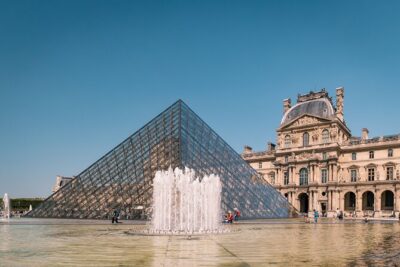
Louvre Museum Masterpieces Guided Tour with Access
Read our review →
Louvre Museum Entry Ticket With Host and River Cruise
Read our review →
Priority Access Louvre with Host -Direct to Mona Lisa
Read our review →
Mona Lisa & Louvre Masterpieces Tour with Reserved Access
Read our review →
Louvre Museum – Exclusive Guided Tour (Entry Included)
Read our review →
Louvre Reserved Ticket and River Cruise Combo
Read our review →Browse the lists this tour appears in