
REVIEW · NORMANDY TOURS
Private Day Tour Omaha beach and Pointe du Hoc
The ground here still tells the story. This private Normandy day tour pairs wide Omaha Beach views with the battered German position at Pointe du Hoc, then adds the American cemetery at Colleville-sur-Mer and your choice of museum. I like the private format, which lets guide Franck shape the day around your interests, and I like the mix of major sites with less usual stops such as the Museum of Underwater D-Day Wrecks. The main consideration is cost: at $744.87 per group, it makes the most sense for several people sharing the vehicle.
Franck is a local guide with a personal connection to the war, and that matters here. His family suffered during World War II, and his interest extends beyond the standard coach-bus route. You should also expect a full day, roughly seven to nine hours, with an 8:30 a.m. start and museum admissions, lunch, and any optional extras paid separately.
In This Review
- Key points to know before booking
- Why a private Omaha Beach tour can be worth the price
- Starting above Omaha Beach
- Wn62 and the hard reality of the landing
- Colleville-sur-Mer American Cemetery
- Choosing the right Omaha museum
- Following Omaha toward Vierville-sur-Mer
- Pointe du Hoc and the Ranger assault
- La Cambe and the German side of the story
- The unusual underwater wreck museum
- Franck’s guiding style and local connection
- Vehicle, family details, and practical limits
- Who should book this Normandy experience?
- Should you book the Omaha Beach and Pointe du Hoc tour?
- FAQ
- Where does the tour start?
- How long does the tour last?
- How many people can join the private tour?
- Is transportation included?
- Are museum admissions included?
- Is lunch included?
- Can children join the tour?
- What is the cancellation policy?
Key points to know before booking
- Private touring for up to eight people: Your group has the air-conditioned vehicle and guide to itself, with no strangers setting the pace.
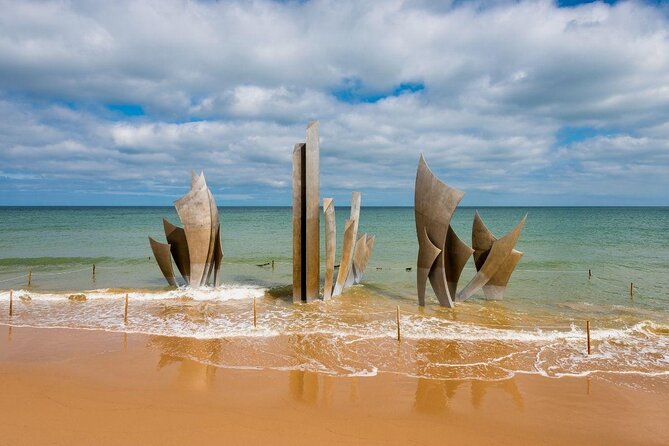
- Omaha is seen from above and below: You first get the sweeping view from the heights, then walk near the German position known as Wn62.
- Franck brings local knowledge and family history: His connection to Normandy gives the military story a human edge.
- You choose the museum: Pick the Overlord Museum, Big Red One Museum, Omaha Beach Memorial Museum, or D-Day Omaha Museum.
- The day includes both American and German sites: Colleville-sur-Mer and La Cambe offer very different settings for remembering the dead.
- Price is per group, not per person: The $744.87 rate can be sensible for six to eight people, but less so for a couple.
Why a private Omaha Beach tour can be worth the price
Normandy is not one tidy monument with a clear beginning and end. The D-Day story stretches across beaches, cliffs, villages, farm roads, cemeteries, bunkers, and museums. A private tour helps connect those points.
This experience is priced at $744.87 for a group of up to eight. For two people, that is a serious expense. For a full group, the per-person cost drops sharply, and you are paying for private transportation, an air-conditioned vehicle, and a guide who can adjust the day to your interests.
That flexibility is the real value. You are not simply being delivered to a beach, given a few minutes, and hurried back to a bus. You have time at Omaha, Wn62, the American cemetery, Pointe du Hoc, and possibly La Cambe. You can also choose the museum that best fits your interests.
The tour runs about seven to nine hours. That range is useful, but it also tells you the schedule has some movement in it. The optional German cemetery and underwater wreck museum depend on timing, so do not treat every listed stop as guaranteed in the same way as Omaha Beach or Pointe du Hoc.
A few more Bayeux outings to set side by side
- Normandy American D-Day Beaches Full Day Tour from Bayeux
★ 5.0 · 2,103 reviews - Normandy American D-Day Experience – Group tour from Bayeux
★ 5.0 · 1,566 reviews - Normandy Beaches Half-Day Afternoon Trip from Bayeux (A2)
★ 4.5 · 1,116 reviews
Starting above Omaha Beach
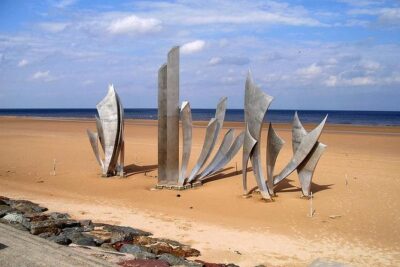
The first view comes from the heights at the eastern end of Omaha Beach. From there, you can look across roughly seven kilometers of shoreline and begin to understand the scale of the operation.
This is a smart way to start. From beach level, the coast can feel like a broad strip of sand. From above, the relationship between the beach, the bluffs, and the German defenses becomes easier to grasp. Franck discusses the June 6, 1944 operations while you have the whole sector in front of you.
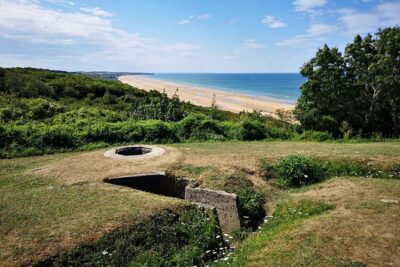
You then go down toward the beach and have time to walk freely near Wn62. That change in viewpoint matters. The heights help you understand the military problem. The beach helps you feel the physical distance that soldiers had to cross under fire.
There is no admission fee for either part of this stop. Wear shoes you can walk in, and bring a layer suited to Normandy weather. The tour is outdoors for much of the day, and the coast can feel very different from the sheltered streets of Bayeux.
Wn62 and the hard reality of the landing
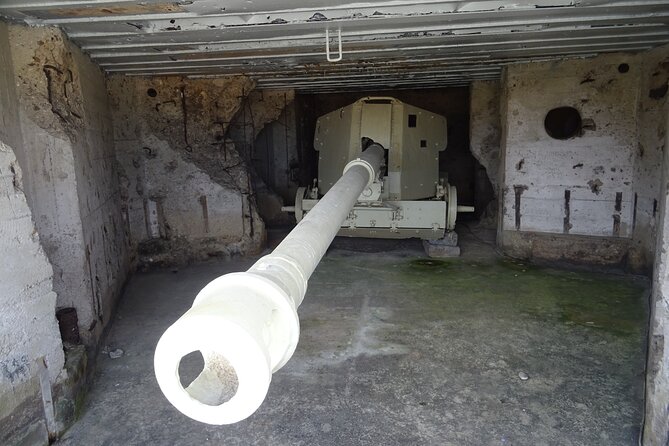
Widerstandsnest 62 was a German fortified position that resisted the assault of men from the 116th Infantry Regiment until the beginning of the afternoon. It is one of the places where the military story becomes sharply specific.
Instead of hearing only broad facts about D-Day, you get a sense of how one defensive position affected the men landing below. The scheduled visit lasts about 30 minutes, which is enough for an explanation and a focused look, though anyone wanting a long walk among the remains may find that time brief.
The position also links directly to the next stop. Many Americans killed in this sector are buried a few hundred meters away at Colleville-sur-Mer. That short physical distance makes the sequence powerful without needing dramatic presentation.
Colleville-sur-Mer American Cemetery
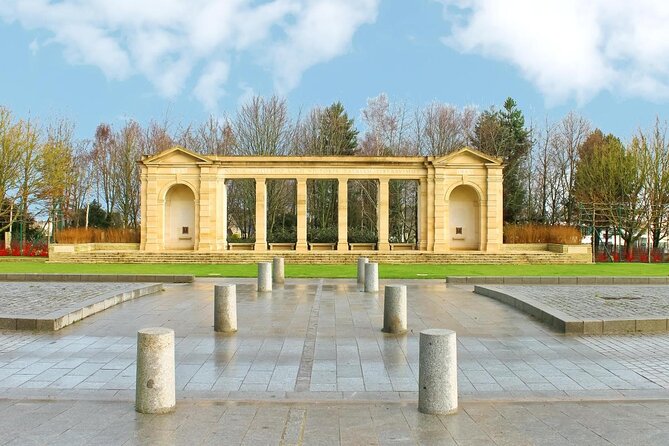
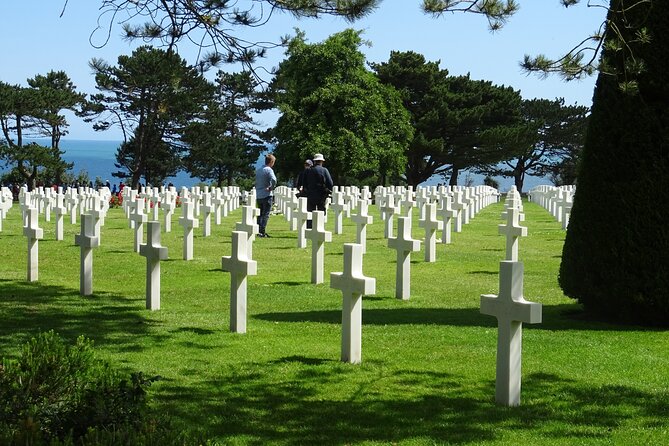
The American military cemetery at Colleville-sur-Mer is given about 45 minutes. You visit at your own pace, which is important in a place that rewards quiet attention more than a rushed lecture.
There are 9,387 soldiers buried here, killed on D-Day or during the Battle of Normandy. The symmetry and scale of the cemetery can be difficult to take in all at once. A private guide can provide context, but you also get space to pause and absorb the setting yourself.
This is one of the most emotional parts of the day, and it follows naturally after Wn62. You have just discussed the German position that caused heavy American losses. You then see where many of those men were laid to rest.
The timing is practical rather than generous. Forty-five minutes lets you visit the cemetery, but you may need to be selective about how long you spend at individual graves. If this site matters greatly to you, tell Franck at the start so you can discuss how to use the available time.
More private outings in Bayeux:
- Private D-Day Experience from Bayeux
★ 5.0 · 573 reviews - Private guided American D-Day Tour from Bayeux
★ 5.0 · 255 reviews - Normandy Battlefields D-Day Private Trip with VIP Services from Paris
★ 5.0 · 240 reviews - Private Day Tour including Normandy Landing Beaches & Battlefields from Bayeux
★ 5.0 · 172 reviews
Choosing the right Omaha museum
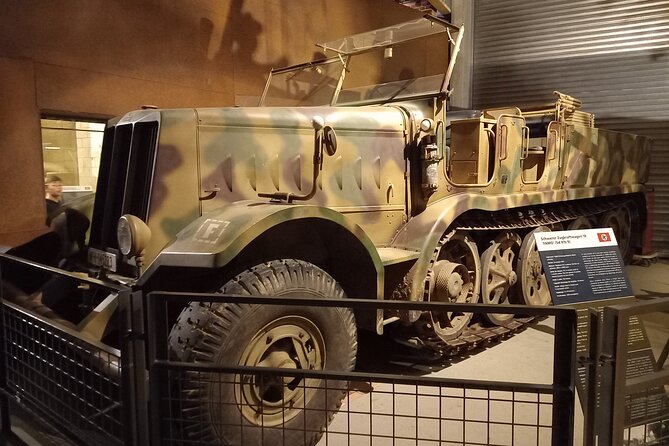
The tour allows about an hour for one museum, with admission not included. You receive a reduced rate arranged through Memory Tracks, and the stated museum prices range from €4.50 to €7 per person.
You can choose among four options:
- Overlord Museum in Colleville-sur-Mer
- Big Red One Museum in Colleville-sur-Mer
- Omaha Beach Memorial Museum in Saint-Laurent-sur-Mer
- D-Day Omaha Museum in Vierville-sur-Mer
This choice is a useful feature, especially if your group has already visited a major D-Day museum elsewhere in Normandy. The collections include uniforms, equipment, vehicles, and other wartime material, but each museum has its own focus and feel.
The Overlord Museum is the named default in the schedule, but it is not your only option. Ask Franck to match the museum to your interests. If you prefer vehicles and equipment, say so. If you want a smaller, more local collection, ask about the alternatives.
A one-hour museum visit is enough for a focused introduction, not a complete study of the campaign. That is fine. The day is built around the actual battlefield, with the museum adding objects and detail rather than replacing the outdoor stops.
Following Omaha toward Vierville-sur-Mer
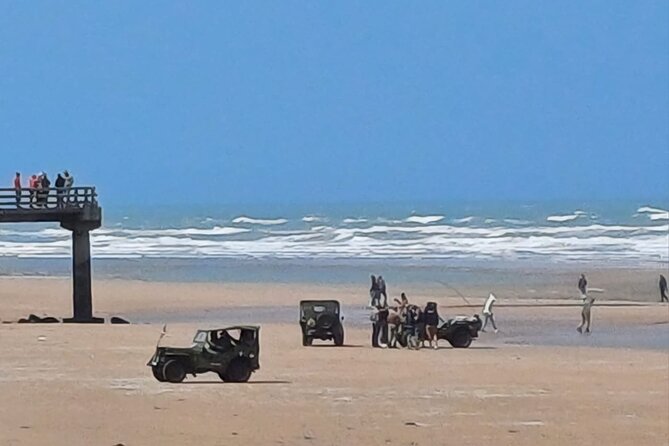
After lunch, you continue west along Omaha Beach through the sectors known as Easy Red, Easy Green, Dog Red, Dog White, Dog Green, and Charlie. This part of the route helps you see that Omaha was not one single landing point.
The stop at Plage de Vierville-sur-Mer lasts about 40 minutes. Here, Franck discusses the fate of Company A of the 116th Infantry and 29th Infantry Division, whose men landed in front of the German fortifications blocking access to the Vierville valley.
This is also the point where a private vehicle earns its keep. You are moving along the shore rather than simply returning to one central parking area. The route follows the beach sectors and connects the physical places with the units and actions discussed during the day.
Lunch is not included. You pay for it yourself, but Franck can offer advice based on what you want. Since the schedule is already long, keep lunch sensible and avoid assuming you will have a large amount of spare time.
Pointe du Hoc and the Ranger assault
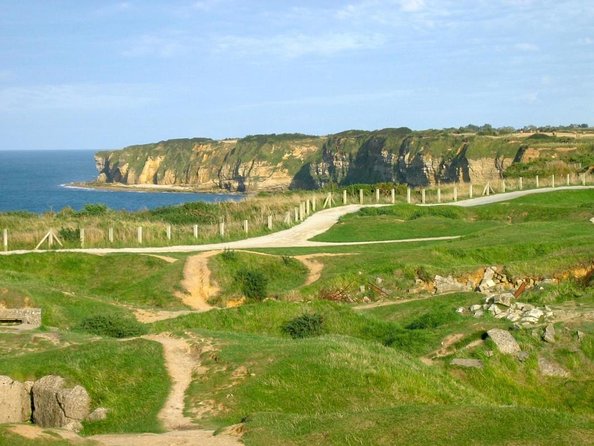
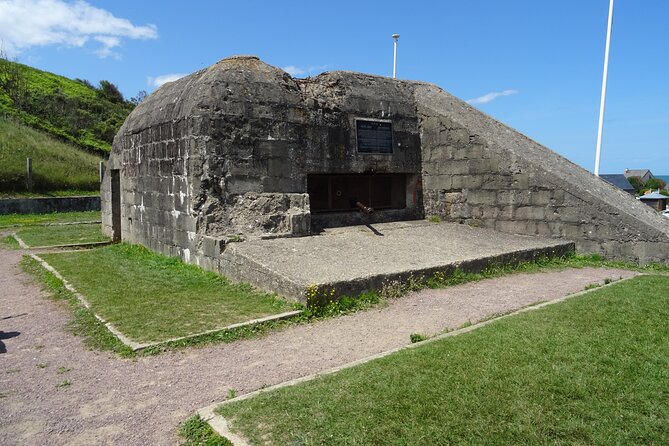
Pointe du Hoc is one of the most recognizable D-Day sites, and the tour gives it about an hour. The stop focuses on the remains of the German artillery battery that threatened both Omaha and Utah beaches.
You learn about the assault by the 2nd Ranger Battalion under Lieutenant-Colonel James Earl Rudder. The story does not end with the initial capture. Franck also discusses the two days and two nights of fighting that followed.
The site itself carries much of the explanation. Nearly 80 years after the battle, the ground remains marked by bombardment. Craters and damaged concrete make this more than a viewpoint with a plaque. You can see why the position mattered and why taking it did not finish the danger for the Rangers.
An hour is a reasonable amount of time for a guided visit, but the ground can be uneven. The tour data does not promise a specific accessibility arrangement, so anyone with mobility concerns should ask before booking. Service animals are allowed, and most people can take part.
La Cambe and the German side of the story
On the return toward Bayeux, the vehicle uses smaller Normandy roads through countryside that has changed little since D-Day. If time allows, you can stop at the German military cemetery at La Cambe for about 45 minutes.
The cemetery contains 21,222 German soldiers killed during the Battle of Normandy. Its atmosphere differs sharply from Colleville-sur-Mer, and seeing both in one day gives you a fuller picture of the human cost.
This stop is optional, so do not book the tour solely for La Cambe if the cemetery is essential to your plans. The operator includes it when the schedule permits. The same applies to the final possible stop, the Museum of Underwater D-Day Wrecks.
Still, the option is valuable. The day begins with American landing operations and ends by acknowledging the German dead as well. That balance does not erase the facts of the invasion, but it gives the visit a wider human frame.
The unusual underwater wreck museum
The Museum of Underwater D-Day Wrecks is described as an unusual collection of equipment and objects recovered from the sea. The material was brought up in the early 1970s by the company of Jacques Lemonchois.
A visit lasts about 45 minutes if the timetable allows. Admission is extra, with the same reduced rate provided through Memory Tracks.
This is likely to appeal most to people who have already seen the better-known museums or who prefer original recovered objects to a standard exhibition. It is not a guaranteed core stop, so keep your expectations flexible. If you want it included, tell Franck early in the day and ask how the timing looks after Pointe du Hoc and La Cambe.
One of the strongest details in the tour’s feedback is that Franck has sometimes taken groups to a local museum run by a collector and discoverer of World War II relics. That kind of adjustment is precisely what a private tour can provide. It also means the exact day can reflect your interests instead of following a fixed script.
Franck’s guiding style and local connection
The most highly praised part of this experience is Franck himself. He is described as highly educated about the events before, during, and after D-Day, but his appeal is not limited to facts.
His family connection to the war helped motivate his study of Normandy’s history and lesser-seen places. That personal link can make the explanations feel grounded, especially when the day moves from troop movements to individual units and graves.
The guide is also praised for kindness, integrity, and a genuinely engaging personality. Those qualities matter during a long day. Military history can become tiring when it is delivered as a list of dates and commanders. A guide who listens to your interests can keep the visit focused and human.
The important point is to speak up. Tell Franck if your priority is American units, German defenses, vehicles, cemeteries, relics, or the wider Battle of Normandy. The tour has enough flexibility to respond, but only if you explain what you want.
Vehicle, family details, and practical limits
Pickup is offered, and the tour uses private transportation in an air-conditioned vehicle. Your group alone takes part, with a maximum of eight people.
Two child car seats are provided for children from birth through age nine. The vehicle cannot take more than two children under 10, so families should confirm that arrangement before booking if they have more than two young children.
The tour is offered in English. Confirmation is sent within 48 hours of booking, subject to availability. The start time is 8:30 a.m., and the day lasts about seven to nine hours.
Most people can participate, and service animals are allowed. The tour is near public transportation, though its main advantage is private road transport between the widely spaced sites.
Free cancellation is available up to 24 hours before the start time. Cancellations or changes made inside that window are not refunded or accepted, based on the local start time.
Who should book this Normandy experience?
I would choose this tour for a family group, a small circle of friends, or anyone making a rare visit to the Normandy battlefields. It is especially useful if you want a guide who can explain the ground rather than simply point out famous names.
The tour also suits people who dislike rigid group schedules. You have a choice of museum, time for free exploration at Omaha and the cemetery, and possible additions such as La Cambe and the underwater wreck museum.
I would think twice if you are traveling alone or as a couple on a tight budget. The group price is high when divided between only one or two people. I would also look elsewhere if you want a specialist tour devoted only to one regiment, one nationality, or one museum.
Should you book the Omaha Beach and Pointe du Hoc tour?
Book it if you want a private, full-day introduction to the key American landing sites and value a local guide who can adjust the route. Franck’s family connection, careful battlefield explanations, and willingness to include less standard museums give this experience more substance than a simple photo stop at Omaha Beach.
The best value comes with four to eight people. Before booking, decide which museum interests you, ask about the optional La Cambe and underwater wreck museum stops, and tell Franck what part of the campaign matters most to you.
For a once-in-a-lifetime Normandy visit, this is a strong choice. For a budget visit or a very narrow military-history project, the price and broad itinerary may not fit.
FAQ
Where does the tour start?
The tour starts at 8:30 a.m. Pickup is offered, and the experience is based in Bayeux, France.
How long does the tour last?
The tour lasts approximately seven to nine hours.
How many people can join the private tour?
Up to eight people can participate, and only your group takes part.
Is transportation included?
Yes. Private transportation in an air-conditioned vehicle is included.
Are museum admissions included?
No. Museum visits are optional and paid separately. The stated admission range is €4.50 to €7 per person, with a reduced rate available through Memory Tracks.
Is lunch included?
No. Lunch is at your own expense. Franck can advise you on lunch options.
Can children join the tour?
Yes. Two car seats are provided for children from birth through age nine. The vehicle cannot accommodate more than two children under 10.
What is the cancellation policy?
You can cancel up to 24 hours before the experience start time for a full refund. Cancellations or changes made less than 24 hours before the start time are not accepted.
Recently added in Bayeux
- WW2 Jeep or Dodge truck tour of the Omaha Beach site★ 5.0 · 51 reviews
- Normandy Battlefields D-Day Private Trip with VIP Services from Paris★ 5.0 · 240 reviews
- 2- to 6-hour sidecar excursion on the D-Day Landing Beaches★ 5.0 · 131 reviews
- Private vintage sidecar tour of the D-Day Landing Beaches★ 5.0 · 130 reviews
- Private Full day American D-Day Guided Tour in Bayeux★ 5.0 · 133 reviews
- Normandy U.S. D-Day Sites Half Day Tour From Bayeux★ 5.0 · 325 reviews
- Private American landing beaches tour from Bayeux★ 5.0 · 36 reviews
- Private guided Allied D-Day Tour from Bayeux★ 5.0 · 45 reviews
Normandy Tours, compared.
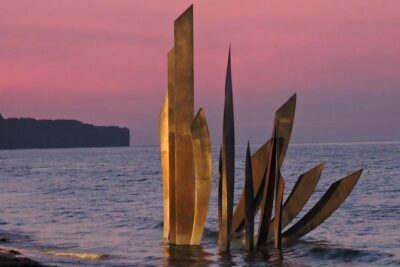
Normandy American D-Day Beaches Full Day Tour from Bayeux
Read our review →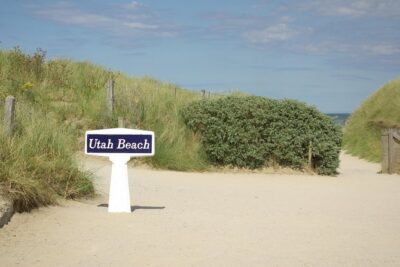
Normandy American D-Day Experience – Group tour from Bayeux
Read our review →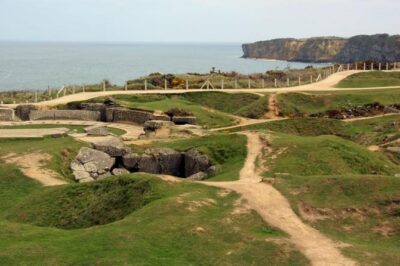
Normandy Beaches Half-Day Afternoon Trip from Bayeux (A2)
Read our review →
Omaha Beach D-Day Experience – Afternoon group tour from Bayeux
Read our review →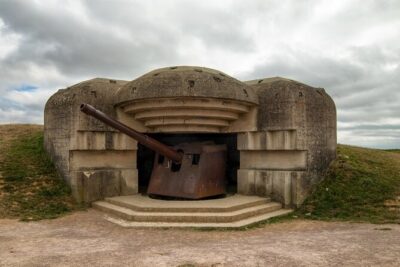
Normandy Battlefields Tour – American Sites (A3)
Read our review →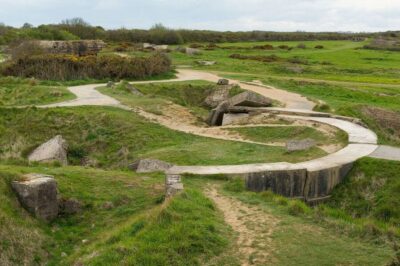
American D-Day Sites in Normandy Half-Day Tour
Read our review →Browse the lists this tour appears in