
REVIEW · SELF-GUIDED TOURS
Carcassonne ‘s Medieval Walls: A Self-Guided Tour
Carcassonne rewards a slower look. This self-guided walk gives you offline audio and geolocation, so you can pause for photos, restart a chapter, or skip a blocked section without losing your place. I also like its focus on medieval warfare, especially the wall defenses and kill zones that turn stonework into a practical battle plan.
The main drawback is simple: this is an audio walk, not a personal guide. You will need your own smartphone and headphones, and museum or castle admission costs extra. A barrier or temporary closure may also force you to move ahead and return to the next chapter later.
In This Review
- Key points before you go
- Why Carcassonne works so well as an audio walk
- Starting with Lady Carcas and a city-saving legend
- Narbonne Gate and the first look at the defenses
- Cathars, crusade, and the conflicts behind the stones
- Following the ramparts and finding the kill zones
- Château Comtal where castle meets wall
- Saint Nazaire Basilica and the gates into the city
- Jean Pierre Cros Mayrevieille and the rescue of the Cité
- What $24.99 gets you, and what it does not
- Who should choose this Carcassonne walk?
- Should you book it?
- FAQ
- How long does the Carcassonne medieval walls audio tour take?
- What language is the tour offered in?
- Where does the tour start?
- Where does the tour end?
- Do I need internet access during the walk?
- Are attraction tickets included?
- Can I cancel for a refund?
Key points before you go
- Lady Carcas begins the story: Start beside the Buste de Dame Carcas and hear how this legendary figure is linked to the city’s survival against Charlemagne.
- The app follows your pace: Audio, maps, and location data work offline, with lifetime access in English.
- The walls become a battlefield: You will identify defensive traps, exposed areas, and kill zones used against attacking forces.
- Cathar history adds moral weight: The walk explains the Cathars, the crusade against them, and the sieges that shaped Carcassonne.
- You see more than the ramparts: The route includes the Aude, Nazaire, and Toulouse Gates, plus Saint Nazaire and Saint Celse Basilica.
- It can save serious money: At $24.99, the tour costs far less than guided options that can run above $130, though it lacks live conversation.
Why Carcassonne works so well as an audio walk
The Cité of Carcassonne can feel almost too perfect at first. Towers, walls, gates, and steep roofs create a storybook skyline, but a quick stroll through the streets only gives you the surface. The audio tour helps you read the fortifications as a working military complex rather than a pretty backdrop.
You get roughly two to three hours, depending on how often you stop. The walk is private in the most practical sense: only your group follows the audio, and you are not tied to a guide’s schedule or the pace of strangers.
I especially like the way the tour lets you control the rhythm. You can pause at a viewpoint, stop for food, take photographs, or wait for a crowded section to clear. One chapter can be restarted, and another can be skipped if restoration work or a barrier interrupts the route.
That flexibility matters at Carcassonne. The old city can become very busy, particularly around the main streets, the castle, and the ramparts. An audio tour cannot remove the crowds, but it can steer your attention away from simply following the largest group.
More walk-it-yourself routes in Toulouse:
- Toulouse: Albi and Cordes/Ciel Day Trip with Audio Guides
★ 4.5 · 486 reviews - Toulouse: Electric Tuk-Tuk Tour with Photo Stops and Audio
★ 4.8 · 138 reviews - From Paris: Giverny Day Trip with Audio Guide or Live Guide
★ 4.3 · 2,372 reviews
Starting with Lady Carcas and a city-saving legend
The meeting point is the Buste de Dame Carcas, the sculpture of Lady Carcas at 11000 Carcassonne. It is a smart place to begin because the figure gives the city its best-known legend and puts a human face on the walls.
The story tells how Lady Carcas saved Carcassonne from Charlemagne. You should treat this as legend rather than a plain military report, but it is an effective opening. Medieval cities were shaped by stories as much as by stone, and this one explains the name Carcassonne through a memorable character.
The opening also helps you get your bearings before the route reaches the larger fortifications. You are not thrown straight into a list of dates and rulers. Instead, the tour begins with a tale, then widens into the city’s military and religious past.
Because the start and end points are different, check the route in the app before setting off. The listed finish is at Porte Narbonnaise, while the walk takes you around the Cité and through several gates. The route is designed as a loop-like circuit of the walls, but the app is your best guide for the exact order on the day.
Narbonne Gate and the first look at the defenses
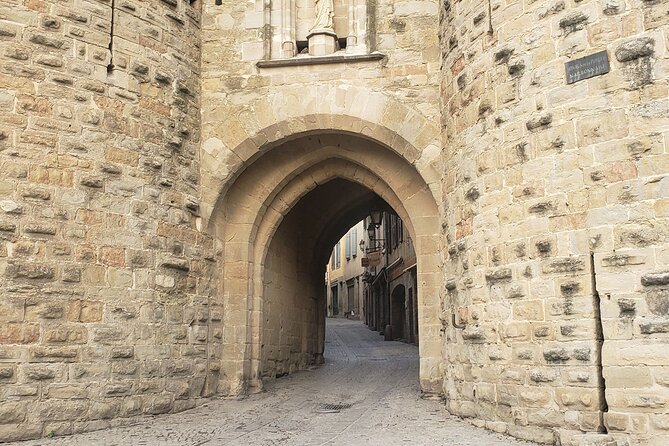
Porte Narbonnaise, or Narbonne Gate, is one of the major gateways into Carcassonne. The audio places the gate within the wider defensive system, so you begin to see that entry was never just a matter of walking through an opening in the wall.
The gate marks an important transition. Outside is the approach to the fortified city. Inside are streets, homes, religious buildings, and the castle. The tour uses this point to introduce the wall that circles the old city and the threats it was built to resist.
This is where the explanations of medieval warfare become useful. Instead of treating the walls as one continuous photo stop, you learn to watch for places where attackers could be exposed or trapped. The phrase kill zone sounds grim, but it describes the practical logic of siege defense: make the enemy visible, slow the advance, and give defenders several ways to attack.
You will not be receiving a weapons demonstration or a museum presentation. The value comes from learning how to look. Towers, gateways, angles, and narrow approaches make more sense once you understand the problems they were meant to solve.
Cathars, crusade, and the conflicts behind the stones
Carcassonne is not only a story of kings and fortresses. The tour explains the Cathars, who flourished in this part of southern France during the twelfth century, and the crusade launched against them.
That subject gives the walk a harder edge. Fortifications can seem romantic when viewed from a distance, but the religious and political conflicts connected to Carcassonne were serious and often violent. The audio places the city within those struggles, then connects them to the sieges that followed.
I like this part because it keeps the experience from becoming a simple list of architectural features. You hear why control of the city mattered and why its defenses were repeatedly tested. The route does not ask you to memorize every name or date. Instead, it links belief, power, territory, and military pressure.
The social side is less developed. If you want a detailed picture of daily life behind the walls, including ordinary work, trade, domestic life, art, or food, you may find the tour leaves you wanting more. Its strongest subject is defense and political conflict.
A few more Toulouse outings to set side by side
- The “Break in Prison” room
★ 5.0 · 609 reviews - Toulouse: Carcassonne Day Trip by Coach with Audioguide
★ 4.4 · 580 reviews - Toulouse Food & History Tour with a Chef (in English)
★ 5.0 · 503 reviews - Toulouse Victor Hugo Market Small Group Tasting Tour
★ 5.0 · 337 reviews
Following the ramparts and finding the kill zones
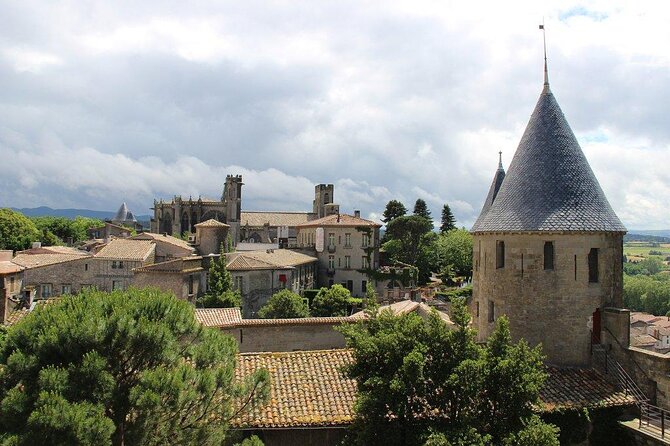
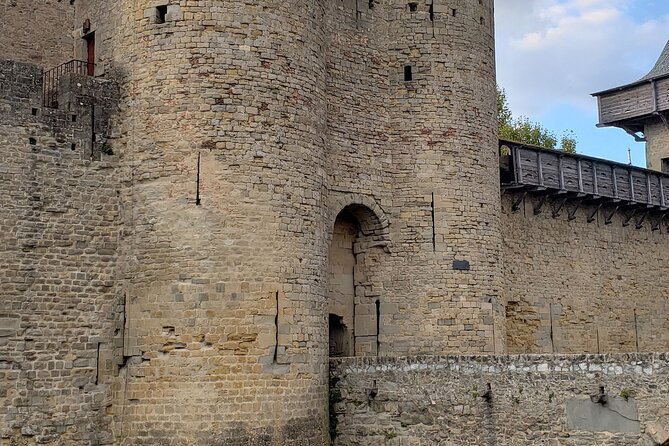
The wall walk is the heart of the experience. As you move around the Cité, the audio points out defensive positions and explains where an attacking force could find itself exposed.
This is the section that benefits most from self-guided timing. You can stop at each location and look before continuing. If you rush, the details may blur together. If you pause, you can match the spoken explanation to the wall, gate, or open area in front of you.
The tour also helps you understand why a siege was rarely a single dramatic assault. Attackers had to approach, climb, breach, and survive repeated attacks from above and from protected positions. A fortified city worked through layers, not one giant barrier.
You should allow extra time if you want photographs or need frequent rests. The stated duration is about two to three hours, but that is not a strict appointment. The app can be paused and resumed, which makes it workable for an older pair or anyone who prefers a less hurried outing.
One practical warning: a new barrier or restoration closure may appear along the route. The audio cannot physically guide you around every change. You may need to follow the map, skip forward, and pick up the next chapter. That is a small weakness, but it is better than being stranded at one blocked point.
Château Comtal where castle meets wall
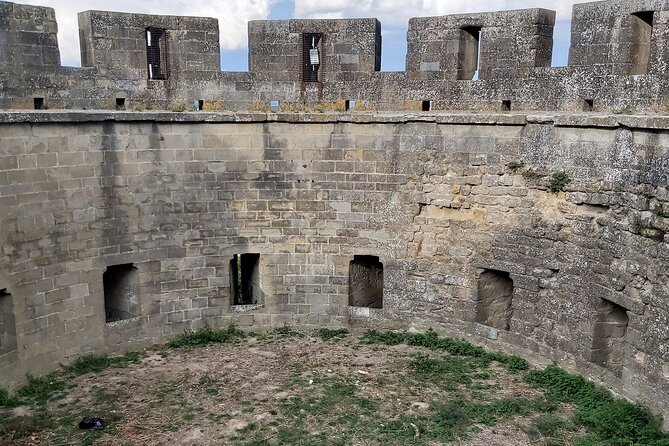
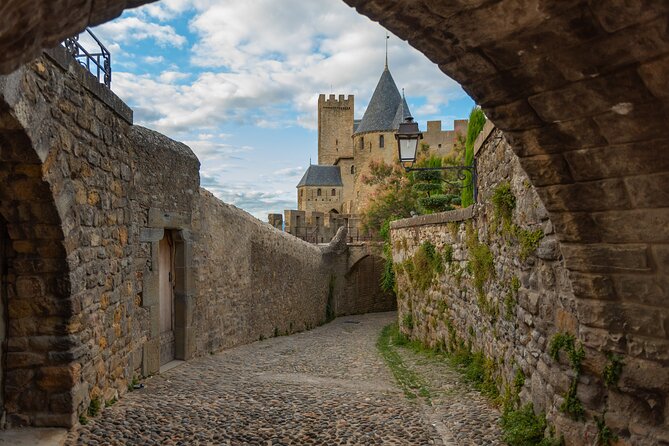
The Château Comtal is the main castle within the Cité, where the central stronghold connects with the surrounding defenses. The tour gives you a useful outside view of this relationship.
You can see the castle not as an isolated palace, but as part of a larger defensive plan. The walls protect the city, while the castle provides another fortified position within it. That arrangement matters when you are thinking about what happened if an outer section came under pressure.
The audio tour does not guide you through the castle interiors. If you choose to visit the Château Comtal or another attraction, you will need to pay the separate entrance fee and explore it independently.
For that reason, I would use this wall walk before entering the castle. The audio gives you military context first, so details inside the castle are easier to place. One strong part of this experience is that it prepares you for a later visit rather than trying to replace every paid attraction in the city.
Do not expect a full castle tour from the $24.99 price. You are paying for interpretation along the public route, not admission, a room-by-room visit, or a live specialist.
Saint Nazaire Basilica and the gates into the city
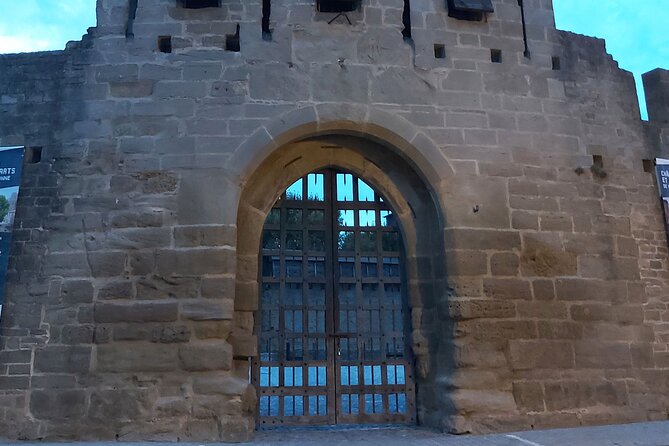
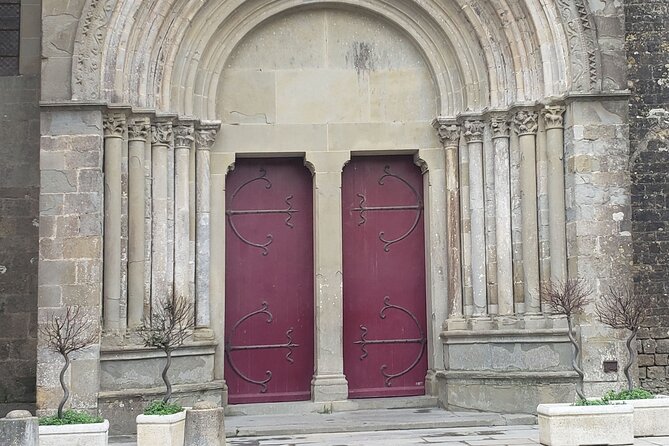
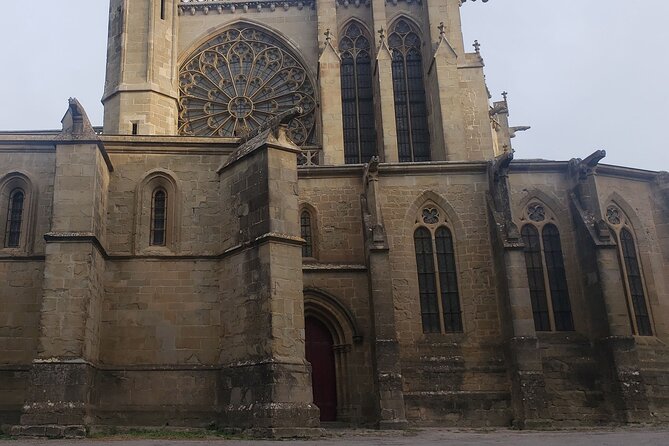
The route moves through the Cité rather than staying on the outer edge. You will pass through the Aude, Nazaire, and Toulouse Gates, and you will see the Church of Saints Nazaire and Celse, the city’s two patron saints.
These stops broaden the experience. Gates show how people and goods entered the city. The church points to the religious life that helped shape the community. Together, they keep the walk from becoming only a military survey.
The basilica is especially useful as a reminder that a fortified city was also a place where people worshipped, worked, traded, and raised families. Still, the audio’s main attention remains on the city’s defenses and political past. You will hear enough to understand the setting, but not a full architectural or religious study.
The various gates also help break up the wall circuit. The route gives you different views of the Cité and lets you step into the center before returning to the defensive line. That variety is welcome on a walk of this length.
Jean Pierre Cros Mayrevieille and the rescue of the Cité
Another important stop is the monument to Jean Pierre Cros Mayrevieille, a doctor of law, historian, and Inspector of Historic Monuments. He played a major role in saving Carcassonne from ruin.
This part adds a modern chapter to the story. The walls may look ancient, but the city did not simply survive untouched. Preservation, restoration, and public interest helped keep the fortifications standing.
That context is valuable because Carcassonne’s appearance can seem too neat and complete. The audio encourages you to think about the work required to preserve such a large historic site, and about the people who argued that it deserved protection.
It also gives the tour a useful final balance. You begin with the legend of Lady Carcas, move through Cathar conflict and siege warfare, and then reach the later effort to protect the city’s physical remains.
What $24.99 gets you, and what it does not
At $24.99 per person, the audio tour is a strong value if you want structure and historical explanation without paying for a private guide. A guided option priced above $130 can make this format look especially attractive for couples, families, or small groups on a budget.
Your purchase includes lifetime access in English through the VoiceMap app for Android and iOS. Audio, maps, and geodata can be downloaded for offline use, which is important if your mobile connection is weak or you want to avoid using data while walking.
You supply the smartphone and headphones. Transportation, food, drinks, and admission to museums, the Château Comtal, or other attractions are not included.
The savings come with limits. You cannot ask the narrator a question, change the route based on your interests, or get an immediate explanation when a restoration barrier appears. For many people, the pause and replay functions make up for that loss. For others, a live guide’s conversation will be worth the extra cost.
Who should choose this Carcassonne walk?
I would recommend it to you if you like history but prefer to move independently. It suits solo walkers, couples, families, and small private groups who want clear direction without joining a scheduled group.
It is also a good fit if medieval warfare interests you. The explanations of siege tactics and defensive kill zones are among the tour’s strongest features. The same is true if you plan to visit the castle afterward, since the wall walk gives you helpful context first.
You may want another option if you dislike using apps, do not have a smartphone, or prefer a guide who can respond to questions. You should also choose a live tour if your main interest is ordinary life inside the medieval city rather than fortifications, religion, and conflict.
The experience is available every day, with the listed operating period running from March 3, 2023, through March 2, 2027. Confirmation is provided at booking, and most people can participate. You can cancel for a full refund up to 24 hours before the scheduled start time, but late cancellations and late changes are not accepted.
Should you book it?
Book this tour if you want a low-cost, flexible way to understand Carcassonne’s walls before or instead of visiting the paid attractions. The offline map, lifetime access, pause function, and strong focus on siege defense make it more useful than a basic recorded narration.
Skip it if you already have a local guide, plan to rely on friends who know the Cité, or mainly want social history and everyday medieval life. For most independent visitors, though, $24.99 buys a well-paced framework for the city, with enough freedom to stop when the view deserves your attention.
FAQ
How long does the Carcassonne medieval walls audio tour take?
The tour takes approximately two to three hours. You can pause and restart it, so the actual time depends on your walking pace and how often you stop.
What language is the tour offered in?
The tour is offered in English.
Where does the tour start?
It starts at the Buste de Dame Carcas, located at 11000 Carcassonne, France.
Where does the tour end?
The tour ends at Porte Narbonnaise, also called Narbonne Gate, after following the walls around the Cité de Carcassonne.
Do I need internet access during the walk?
No. The VoiceMap app provides offline access to the audio, maps, and geodata.
Are attraction tickets included?
No. Tickets for museums, the Château Comtal, or other attractions along the route are not included. Food, drinks, transportation, a smartphone, and headphones are also excluded.
Can I cancel for a refund?
Yes. You can receive a full refund if you cancel at least 24 hours before the experience start time. Cancellations or changes made less than 24 hours before the start are not accepted.
Recently added in Toulouse
- Private guided tour of the city of Carcassonne★ 5.0 · 58 reviews
- Guided tour of the City of Carcassonne (on foot)★ 5.0 · 26 reviews
- Medieval Carcassonne: Interactive Ghost Story & City Game★ 3.5 · 33 reviews
- Cité de Carcassonne Guided Walking tour. Private tour.★ 5.0 · 42 reviews
- Carcassonne During World War 2★ 5.0 · 127 reviews
- Toulouse Food & History Tour with a Chef (in English)★ 5.0 · 59 reviews
- Welcome to Toulouse: Private Walking Tour with a Local★ 4.2 · 47 reviews
- Toulouse: Electric Tuk-Tuk Tour with Photo Stops and Audio★ 4.8 · 138 reviews
Self-Guided Tours, compared.

Giverny Day Trip with Audio Guide or Live Guide
Read our review →
Giverny and Monet’s House Half Day Trip from Paris Guide or Audio
Read our review →
Catacombs Entry & Seine River Cruise with Audio Guide
Read our review →
Versailles Palace Self Guided & Gardens tickets
Read our review →
Catacombs, Audio Guide, and River Cruise Option
Read our review →
Openair Double Decker Bus Audio-Guided City Tour
Read our review →
Bruges Guided or Audio Trip with Canal Cruise Option from Paris
Read our review →
Albi and Cordes/Ciel Day Trip with Audio Guides
Read our review →Browse the lists this tour appears in