
REVIEW · LOUVRE MUSEUM TOURS
Louvre Museum: Mona Lisa Without the Crowds Last Entry Tour
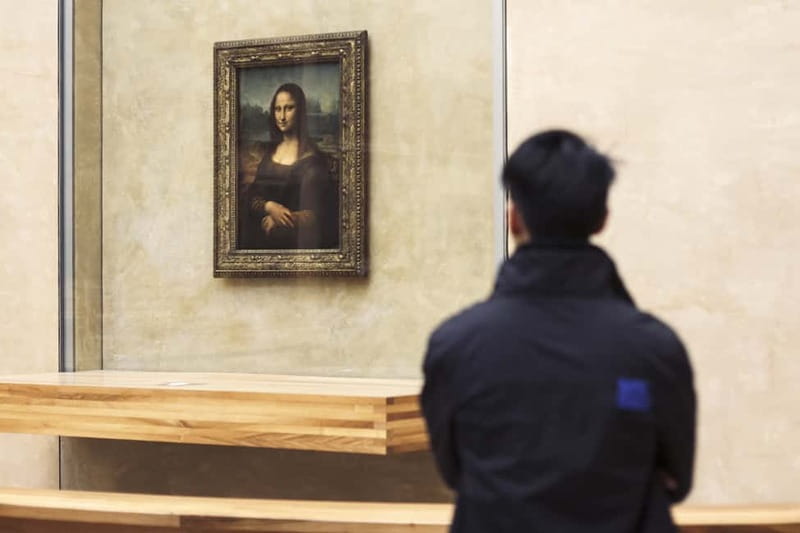
The Louvre gets better as the day fades. This three-hour evening visit combines skip-the-line entry with a small group of no more than 15 people, giving you a practical way to see major works by Leonardo da Vinci, Michelangelo, Raphael, Caravaggio, and Delacroix. I especially like the final visit to the Mona Lisa, when the room is usually calmer, and the guides, including Hugo, Violette, Claire, Adam, and Antoine, have earned high praise for lively explanations and good humor.
I also like that the tour gives the Louvre a shape instead of sending you into its enormous galleries alone. You see the palace foundations, Greek sculpture, French painting, famous Italian works, and the Crown Jewels in one brisk route. The main consideration is pace: three hours goes quickly, and this is a walking tour through a huge museum. It is not suitable for wheelchair users, people with mobility impairments, or anyone bringing a stroller.
In This Review
- Key points to know before you book
- Why a late Louvre visit makes sense
- Finding the Arc de Triomphe du Carrousel
- Beneath the palace: the Louvre’s foundations
- Greek sculpture and the museum’s famous marble figures
- Cupid and Psyche, Michelangelo, and French revolution
- Italian masterpieces from Caravaggio to Leonardo
- The Raft of Medusa and the Crown Jewels
- The final half-hour with the Mona Lisa
- What the guides add to the experience
- Group size, pace, and practical limits
- Who gets the best value from this tour?
- Should you book the Louvre last-entry tour?
- FAQ
- How long does the Louvre Mona Lisa last-entry tour last?
- Where does the tour meet?
- Is this the Arc de Triomphe on the Champs-Élysées?
- Is museum admission included?
- Is the tour suitable for wheelchair users or people with mobility impairments?
- What language is the tour conducted in?
Key points to know before you book
- The Mona Lisa comes last: You reach Leonardo’s small but famous painting near closing time, when the room can feel less hectic.
- A strong first visit to the Louvre: The route covers major works and important rooms without trying to show you everything.
- Small groups help: With a maximum of 15 people and headsets, you can hear the guide more easily in crowded galleries.
- Guides add context: Hugo, Violette, Laurence, Claire, Adam, and others have been praised for linking art with politics, society, and French history.
- The meeting point needs care: You meet at the Arc de Triomphe du Carrousel, not the better-known arch on the Champs-Élysées.
- Plan for steady walking: Comfortable shoes are essential, and large bags, luggage, strollers, and oversize items are not permitted.
Why a late Louvre visit makes sense
The Louvre is not a museum you casually pop into for half an hour. It is a former royal palace with thousands of rooms and an enormous collection, so the hardest part is often deciding where to go first. A guide gives you a route and helps you spend your limited time on works that matter.
This tour begins late in the day and saves the Mona Lisa for the final 30 minutes. That timing is the main reason to consider it. The painting draws a crowd at nearly every hour, but closing time can bring a little more breathing room. You should not expect an empty room every time. One account describes the crowd as reasonable enough for a good look and a photo, while others specifically enjoyed seeing the painting with no crowd around them.
The late timing also changes the mood of the visit. You start with the museum’s major rooms, then finish with Leonardo’s portrait as the building prepares to close. It gives the tour a clear ending rather than leaving you tired and directionless in the middle of the Louvre.
The stated price is $97 per person. That is not cheap, but it includes museum admission, skip-the-line entry, a live English-speaking guide, and headsets. I see the best value here for a first visit, a short stay in Paris, or anyone who wants help finding the essential works without spending hours planning a route.
More Louvre visits and guided rooms:
- Paris: Louvre Museum Timed-Entrance Ticket
★ 4.6 · 71,977 reviews - Paris: Louvre Guided Tour with Reserved Access & Boat Cruise
★ 4.3 · 16,353 reviews - Louvre Museum Masterpieces Guided Tour with Access
★ 4.5 · 12,023 reviews
Finding the Arc de Triomphe du Carrousel
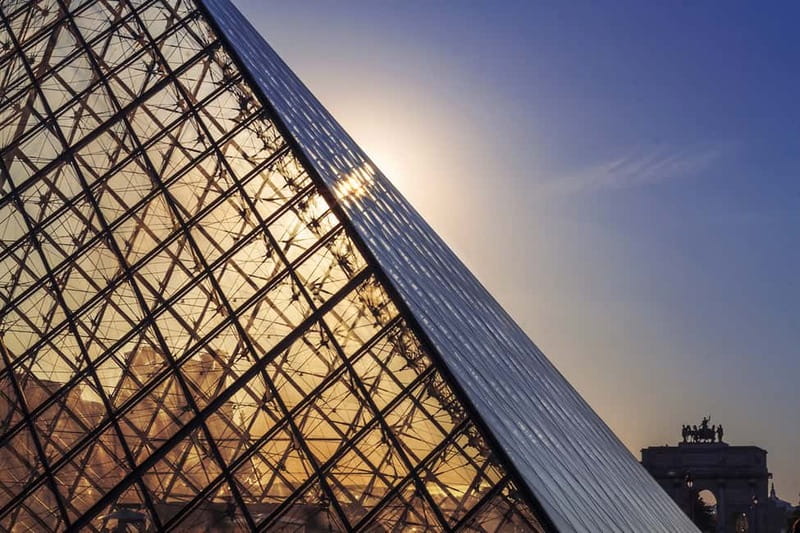
The meeting point is one of the tour’s few practical traps. You meet at the statue beside the Arc de Triomphe du Carrousel, in front of the Louvre and opposite the pyramid entrance from the Tuileries Gardens.
Do not go to the Arc de Triomphe de l’Étoile on the Champs-Élysées. That is a completely different monument. When you face the Carrousel arch, meet at the winged statue on the left. Your guide will be holding a green Walks sign.
Arrive 15 minutes early. One person had trouble locating the guide because the meeting point is away from the main museum entrance. This is a good reason not to cut things close, especially if you are unfamiliar with the Louvre complex.
The tour finishes back at the Louvre meeting point. Hotel pickup and drop-off are not included, so you need to arrange your own way to and from the museum.
Beneath the palace: the Louvre’s foundations
The first stop takes you below the modern museum to the remains of the original fortress moat and foundations. This is an important opening because the Louvre is not simply a gallery placed inside a palace. The building developed over many centuries, changing from a defensive structure to a royal residence and then to a public museum.
You will walk through this opening section with the guide, who explains how the site changed over time. It gives you a useful mental map before the art begins. Without that context, the Louvre can feel like a grand collection of disconnected rooms.
The route is not designed for leisurely wandering. You move at a moderate pace, and the guide keeps the group together as you pass from one section to the next. That is useful in a museum this large, but it also means you should not expect to stop at every painting that catches your eye.
Greek sculpture and the museum’s famous marble figures
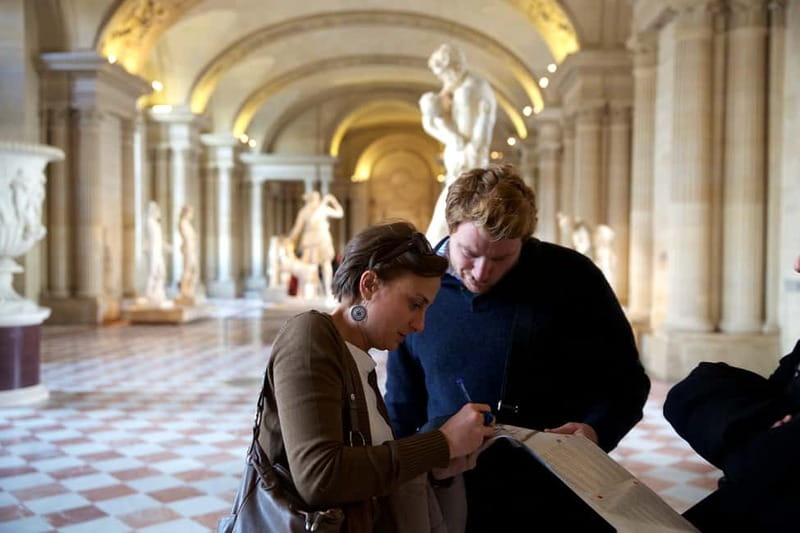
The tour then moves to Classical Greek sculpture, including the Venus de Milo and the Winged Victory of Samothrace. These are two of the Louvre’s most recognizable works, and their placement gives the route a dramatic lift.
The Venus de Milo is famous partly because of what is missing: her arms. A good guide can help you look beyond the familiar outline and consider the pose, proportions, and way the sculpture has been displayed and interpreted.
The Winged Victory is a different experience. You see her at the top of a grand staircase, with her wings and drapery suggesting movement even though she is carved in stone. The setting is part of the effect. Your guide can explain why the work feels triumphant before you have even considered its details.
You will likely pause for explanation rather than simply walk past for a quick photograph. That is where the tour earns its keep. People who praised guides such as Laurence, Violette, and Bel especially valued their ability to connect the objects with the society and events that produced them.
More museums in Paris:
- Paris: Louvre Museum Entry Ticket With Host and River Cruise
★ 4.6 · 9,926 reviews - Les Invalides: Napoleon’s Tomb & Army Museum Entry
★ 4.6 · 9,185 reviews - Louvre Museum – Exclusive Guided Tour (Entry Included)
★ 5.0 · 6,296 reviews - Paris: Louvre Museum Hosted Entry and Mona Lisa Audioguide
★ 4.6 · 5,235 reviews
Cupid and Psyche, Michelangelo, and French revolution
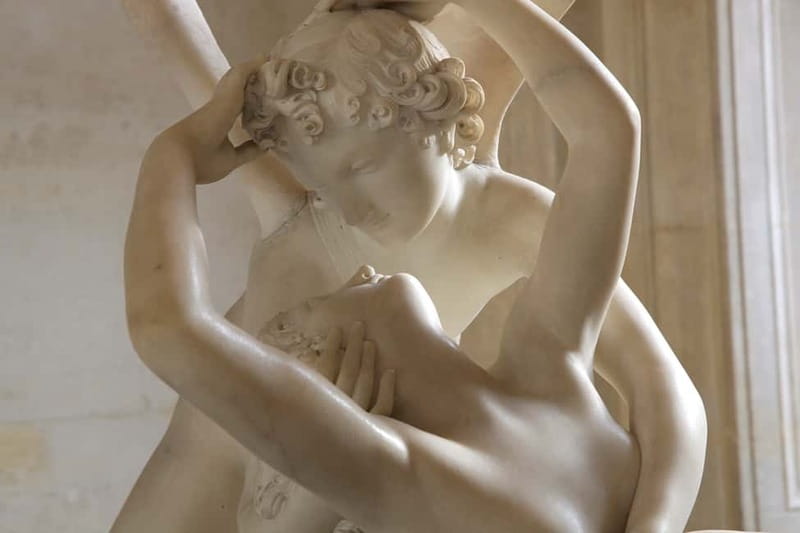
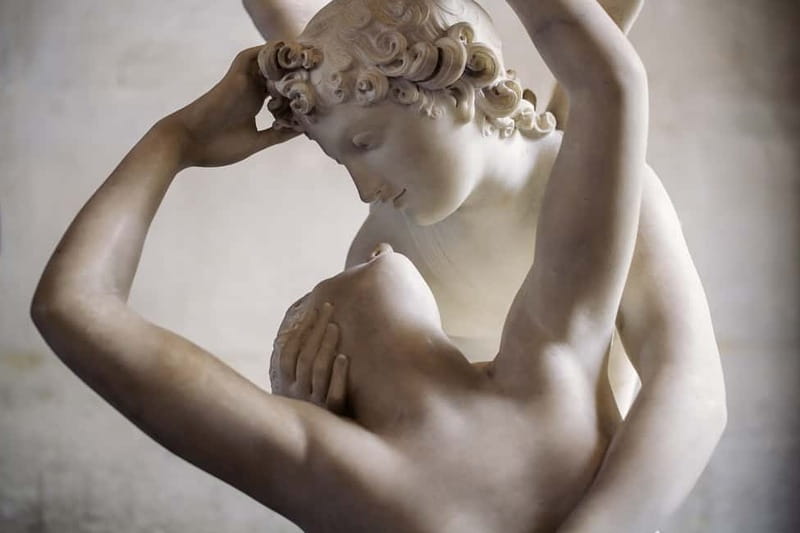
The next sections bring together sculpture and French painting. You may see Cupid and Psyche, a work admired for its polished marble surfaces and gentle pose, followed by Michelangelo’s Slaves.
Michelangelo’s unfinished figures are particularly useful on a guided route because they raise questions that a quick visit can miss. You can look at the bodies emerging from the stone and consider the relationship between intention, labor, and unfinished form. The guide’s explanation helps you see why an incomplete sculpture can still be a major work.
Delacroix’s Liberty Leading the People shifts the subject from myth and idealized bodies to revolution and political struggle. The painting is often reduced to its instantly recognizable woman holding the flag, but the surrounding figures and crowded composition matter just as much.
This is one of the places where the guides receive their strongest praise. Bel was noted for tying art to world events, while Laurence explained how works reflected their own period and later influenced other artists. That kind of context is valuable because it keeps the tour from becoming a parade of famous names.
Italian masterpieces from Caravaggio to Leonardo
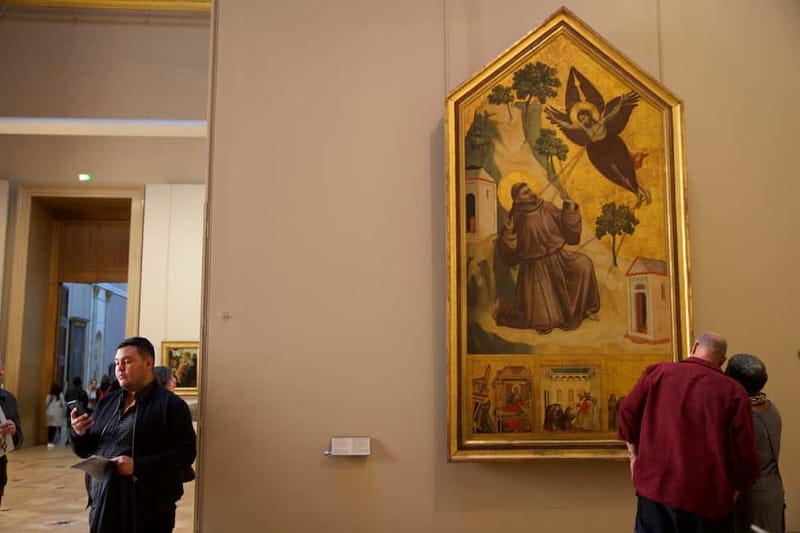
The Louvre’s Italian rooms can overwhelm you. The tour narrows the field to important works by Caravaggio, Raphael, and Leonardo da Vinci, giving you enough information to appreciate the paintings without attempting a full survey of Italian art.
Caravaggio’s work rewards close looking. His strong contrasts of light and dark direct your eye and heighten the drama of the scene. Raphael offers a different kind of balance and grace, while Leonardo brings careful observation, psychological ambiguity, and technical control.
The guide’s role here is not only to identify the artist. You learn what to notice, why the work mattered, and how artistic choices relate to the period. Hugo was praised for adding music clips to his explanations, and several guides were described as energetic storytellers rather than people who simply recite dates.
The headsets are useful in these galleries. Even with a group limited to 15, the museum can be noisy, and you may be looking at a work from several feet away while the guide speaks. The equipment lets you listen without standing shoulder to shoulder around the guide.
The Raft of Medusa and the Crown Jewels
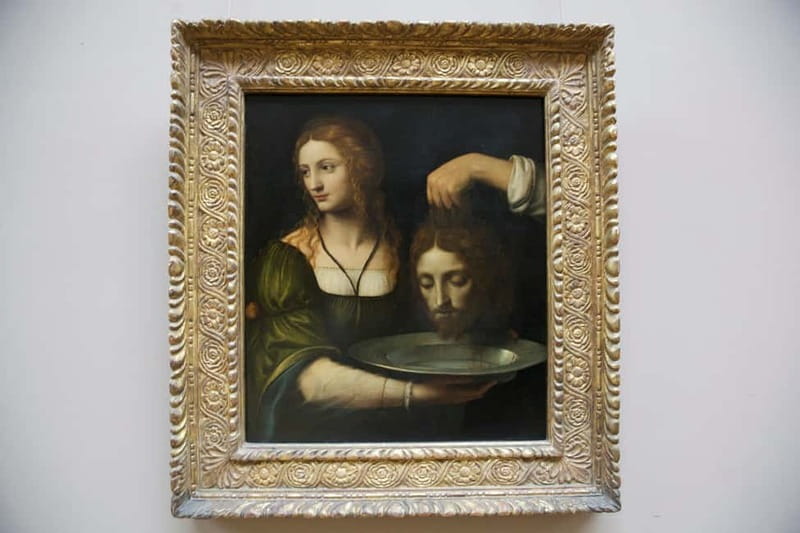
Géricault’s The Raft of Medusa brings the tour into the Romantic period. The enormous painting depicts survivors at sea, and its scale, emotion, and difficult subject make it one of the Louvre’s most memorable stops.
Your guide can help you read the composition from the foreground bodies to the distant rescue ship. This is the sort of painting that can look merely dramatic until someone explains the real event and the political criticism behind it.
The route also includes a room sparkling with Crown Jewels. It gives you a change of pace after the paintings and sculpture. The objects show royal wealth in a direct, almost dazzling way, while also helping explain the power and ceremony associated with the French monarchy.
One useful feature of this route is its range. In three hours, you move from ancient foundations to Greek sculpture, Renaissance painting, Romantic drama, and royal objects. You do not see the entire Louvre, but you get a strong introduction to the museum’s main artistic and historical themes.
The final half-hour with the Mona Lisa
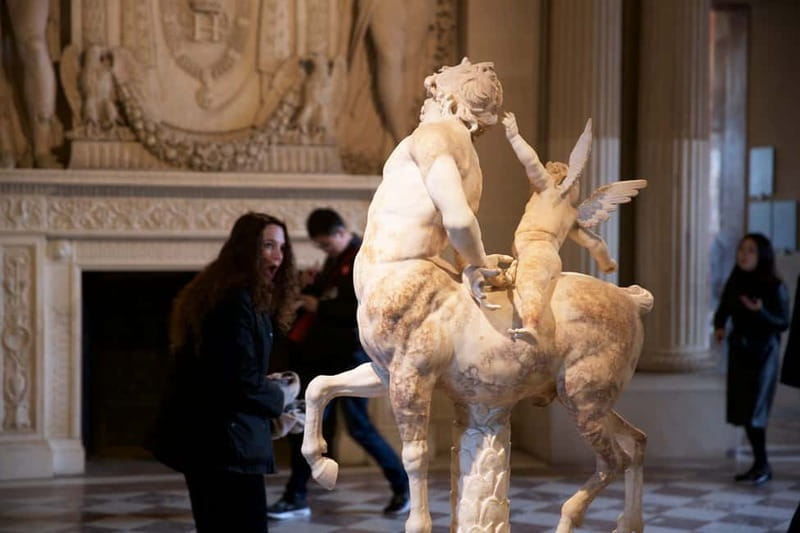
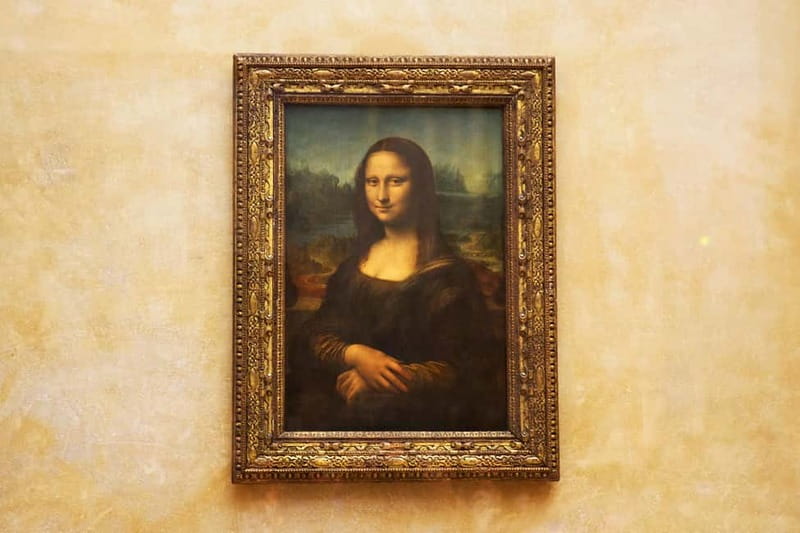
The Mona Lisa visit takes about 30 minutes and comes at the end. You enter the painting’s room with your guide, then have time to look at Leonardo’s portrait and take photographs.
The painting is smaller than many first-time visitors expect. That is part of the surprise. Its fame is enormous, while the actual panel is modest in size, protected behind glass, and viewed by people eager to get a clear look.
The late-entry arrangement is designed to improve this moment. You may have space to approach more comfortably, step back, and study the face without being pushed along by a dense daytime crowd. The expression remains famously difficult to pin down, and you can spend a few minutes deciding for yourself what you see in it.
Still, keep expectations sensible. The Mona Lisa is one of the world’s most popular paintings, and quieter does not always mean private. The tour improves your chances of a calmer visit, but it cannot promise the room will be empty.
After the Mona Lisa, you leave the museum with your guide. This is not the time to begin a separate, self-guided expedition through the Louvre. The activity ends back at the meeting point, and the closing schedule may limit what you can do afterward inside the building.
What the guides add to the experience
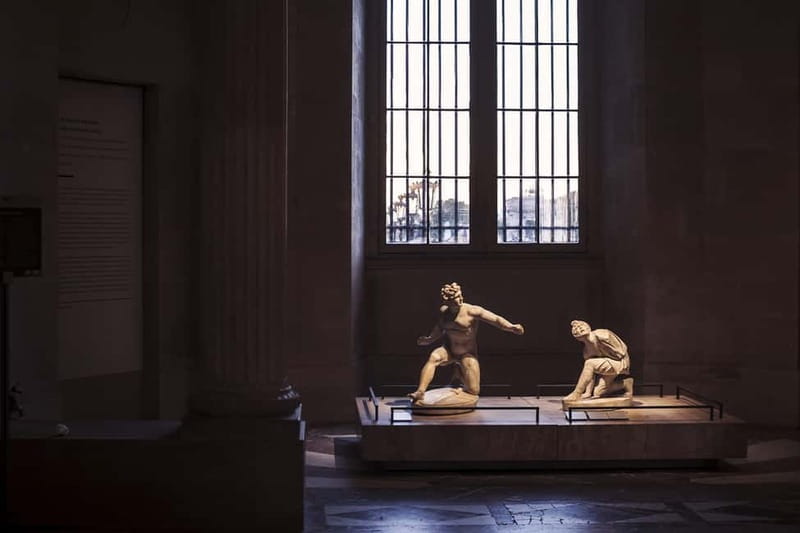
The guide is the biggest variable in any art tour, and the praise here is unusually consistent. Hugo is described as welcoming, funny, and full of useful detail. Violette is repeatedly praised for energy, humor, and clear explanations. Claire is remembered for being warm, informative, and entertaining, while Adam brought enthusiasm for both the Louvre and Paris.
Other names that appear in strong accounts include Laurence, Lee, Bel, Antoine, Abby, Karen, Daniel, and Manuel. The individual guide depends on the date, so you should not book expecting one particular person unless the provider confirms it.
The common thread is interpretation. You are not simply shown a room and told the name of a painting. The best guides explain social conditions, political events, artistic methods, and the connections between works. One guide even kept three generations, from age 14 to 81, engaged throughout the visit.
That matters if your group includes teenagers or people who do not normally spend hours in museums. A good story can make a work memorable. It can also stop the Louvre from feeling like an endless march through polished floors and famous faces.
Group size, pace, and practical limits
The small-group format allows up to 15 people. That is intimate enough for questions and easier movement, though it is not a private tour. You will still share the galleries with the museum’s other visitors.
The pace is moderate, but you need to walk for most of the three hours. Wear comfortable shoes. Bring a passport or ID card, since identification is listed among the required items.
Strollers are not allowed, and the tour is not suitable for wheelchair users or people with mobility impairments. Large bags, luggage, and oversize items are also prohibited. If you are traveling with suitcases, make other arrangements before arriving at the meeting point.
The tour is conducted in English. Full first and last names for everyone in your party, including children, must be supplied when booking. Missing names can result in cancellation, so check the reservation carefully.
Museum rooms can close without warning, and the route may change on the day. That is normal for a large working museum, but it is worth knowing if you have one particular room on your must-see list.
Who gets the best value from this tour?
I would choose this tour for a first Louvre visit, especially if you have limited time in Paris. It gives you a sensible route through major sections and removes the stress of locating the museum’s most famous works.
It also suits people who want art explained in plain language. You do not need a background in art history. The guides focus on stories, visual details, and historical meaning, so you can follow along even if you usually feel unsure in museums.
Families can benefit from the short stops and changing subjects. The positive experience with a group ranging from a 14-year-old to an 81-year-old suggests that the format can work across ages, provided everyone can maintain the walking pace.
I would be more cautious if you want long, quiet periods with individual paintings. The route is selective and time-controlled. If you already know the Louvre well, you may prefer a ticket that lets you choose your own rooms and stay as long as you like.
Should you book the Louvre last-entry tour?
Book it if you want the Louvre’s essential works, a clear three-hour route, and a better chance of seeing the Mona Lisa without the worst daytime crush. The combination of skip-the-line entry, a group capped at 15, headsets, and an English-speaking art historian makes $97 reasonable for a first visit, particularly when your time in Paris is short.
Skip it if you need full wheelchair access, want to bring luggage or a stroller, or hope to explore the museum at your own pace. The late visit can be quieter, but it is not guaranteed to be crowd-free, and the collection areas may change.
For most first-time visitors who would rather understand a handful of major works than wander lost among thousands, this is a smart way to meet the Louvre.
FAQ
How long does the Louvre Mona Lisa last-entry tour last?
The tour lasts three hours. About two and a half hours are spent on the guided Louvre route, followed by about 30 minutes in the Mona Lisa room.
Where does the tour meet?
It meets at the statue beside the Arc de Triomphe du Carrousel in front of the Louvre, opposite the pyramid entrance from the Tuileries Gardens. When facing the arch, meet at the winged statue on the left.
Is this the Arc de Triomphe on the Champs-Élysées?
No. The meeting point is the Arc de Triomphe du Carrousel beside the Louvre. It is not the Arc de Triomphe de l’Étoile on the Champs-Élysées.
Is museum admission included?
Yes. The tour includes skip-the-line entry to the Louvre Museum, a local guide, and headsets.
Is the tour suitable for wheelchair users or people with mobility impairments?
No. The activity is not suitable for wheelchair users or people with mobility impairments. Strollers are also not allowed.
What language is the tour conducted in?
The tour is conducted in English with a live English-speaking guide.
Recently added in Paris
- Private Transfers in Paris★ 5.0 · 75 reviews
- CDG – Euro Disney – CDG Two Way Private Shuttle Transfer★ 5.0 · 233 reviews
- Disneyland® Paris 1 Day Ticket with Transport from Paris★ 3.5 · 302 reviews
- Personalized Transport service from Disneyland to Paris★ 5.0 · 63 reviews
- Monet’s Gardens & House-Private Giverny Tour From Paris★ 4.5 · 137 reviews
- Guided tour Monet’s house and gardens/small group★ 4.5 · 68 reviews
- Giverny Monet House and Gardens Skip the line Walking tour★ 4.0 · 217 reviews
- Monet’s House and Garden & Giverny Village★ 4.5 · 39 reviews
Louvre Museum Tours, compared.


Louvre Guided Tour with Reserved Access & Boat Cruise
Read our review →
Louvre Museum Masterpieces Guided Tour with Access
Read our review →
Louvre Museum Entry Ticket With Host and River Cruise
Read our review →
Priority Access Louvre with Host -Direct to Mona Lisa
Read our review →
Mona Lisa & Louvre Masterpieces Tour with Reserved Access
Read our review →
Louvre Museum – Exclusive Guided Tour (Entry Included)
Read our review →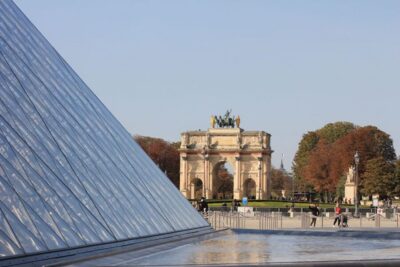
Louvre Reserved Ticket and River Cruise Combo
Read our review →Browse the lists this tour appears in