REVIEW · TICKETS
Paris: Sainte-Chapelle and Conciergerie Combined Tickets
Paris keeps a few surprises behind courthouse doors. This combined ticket brings you to two very different monuments on Île de la Cité: Sainte-Chapelle, with its dazzling stained glass, and the Conciergerie, a former royal palace and prison tied to the French Revolution. I like the strong contrast between beauty and political history, and I like having one booking for both sites. The catch is that prepaid tickets do not always remove the security queue, so allow extra time.
Sainte-Chapelle is the clear star for most people, especially when the upper chapel is glowing with color. I also like the Conciergerie’s HistoPad, which uses 3D reconstructions and augmented reality to bring vanished rooms and Marie-Antoinette’s cell to life. Still, the chapel is small, the sites can feel crowded, and this is mainly an admission ticket rather than a guaranteed guided tour.
In This Review
- Key points to know before you book
- Two monuments, two very different visits
- Sainte-Chapelle: Paris’s great stained-glass room
- Why the windows deserve your full attention
- The Conciergerie: from royal residence to revolutionary prison
- Marie-Antoinette’s cell and the HistoPad
- Queues, security, and finding the entrance
- Is the $27 price good value?
- Who should book this Paris experience?
- Practical plan for a smooth visit
- Should you book the combined ticket?
- FAQ
- Where are Sainte-Chapelle and the Conciergerie located?
- How long is the ticket valid?
- Do I choose a time for Sainte-Chapelle?
- Does the ticket include a guided tour?
- Is the Conciergerie HistoPad available in English?
- What identification should I bring?
- Who can enter free of charge?
- When are the monuments closed?
Key points to know before you book
- The upper chapel is the main event: Its tall stained-glass windows fill the room with jewel-like color and tell biblical stories in hundreds of panels.
- The Conciergerie changes the mood: Medieval halls, prison cells, and revolutionary-era displays give the visit a darker but important side.
- One ticket covers both monuments: You can visit Sainte-Chapelle and the Conciergerie on the same day, with the Sainte-Chapelle time selected at booking.
- Security can slow you down: Expect ID checks and screening near the Palais de Justice, even with a prepaid ticket.
- The HistoPad helps at the Conciergerie: Its digital reconstructions are available in several languages and are especially useful for understanding rooms that no longer exist.
- Plan for roughly two to three hours: One visit took about two and a half hours, and it could easily take longer if you study the windows and displays carefully.
Two monuments, two very different visits
The combined ticket works because Sainte-Chapelle and the Conciergerie sit together within the old Palais de la Cité complex. You are not spending half the day crossing Paris between attractions. The two entrances are at 2 Boulevard du Palais, 75001 Paris, though the precise access point can vary on weekends, public holidays, Christmas holidays, and some Mondays without a court audience.
I would plan this as a single Île de la Cité outing. Notre-Dame is close enough to pair with it in the same morning or afternoon, as several visitors found, but do not squeeze the chapel between tight reservations. Security lines are unpredictable, and the windows deserve more than a quick photograph.
The ticket is valid for one day. You choose a date and time for Sainte-Chapelle, and the Conciergerie visit must take place that same day at the selected time. Read the booking instructions carefully, since the wording around the Conciergerie time can be easy to misunderstand.
More entry tickets in France:
- Paris: Louvre Museum Timed-Entrance Ticket
★ 4.6 · 71,977 reviews - Disneyland® Paris 1-Day Ticket
★ 4.6 · 49,412 reviews - Paris: Versailles Palace and Gardens Full Access Ticket
★ 4.6 · 41,579 reviews
Sainte-Chapelle: Paris’s great stained-glass room
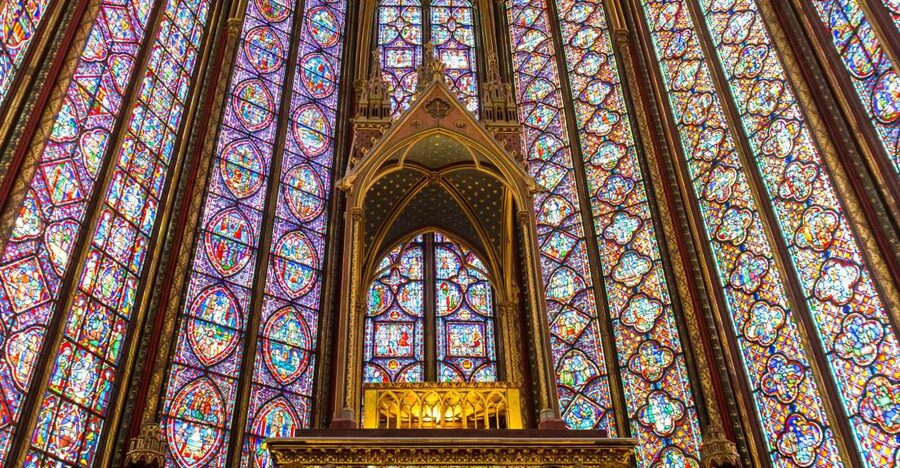
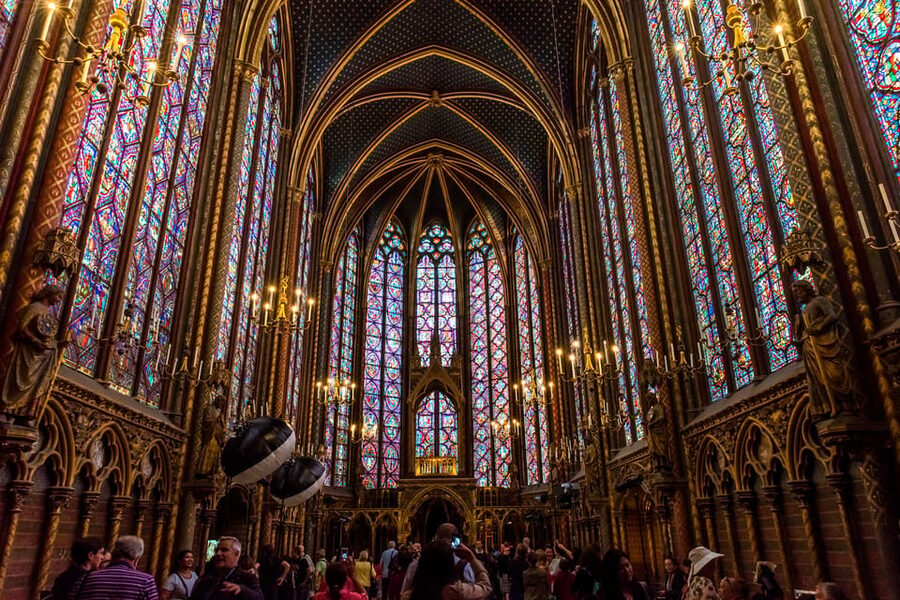
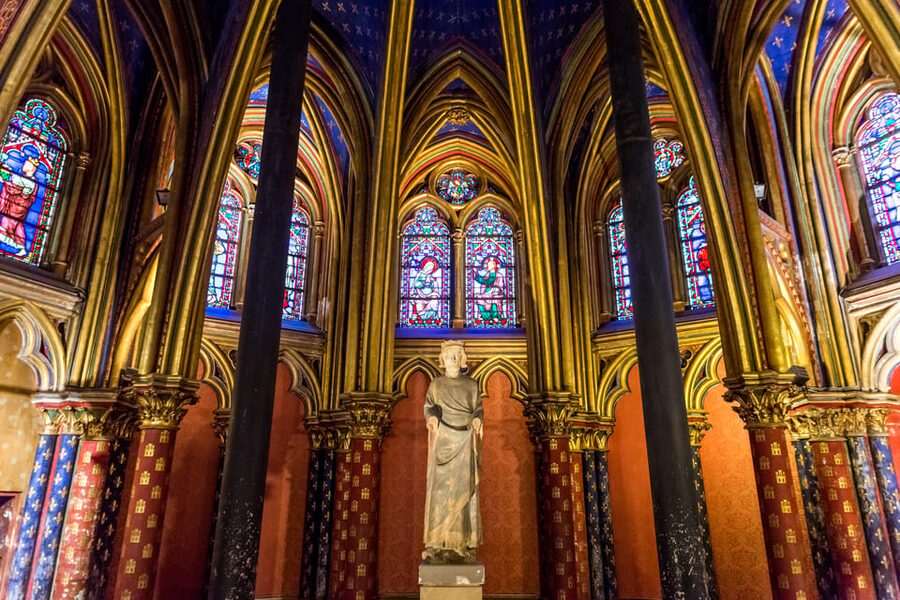
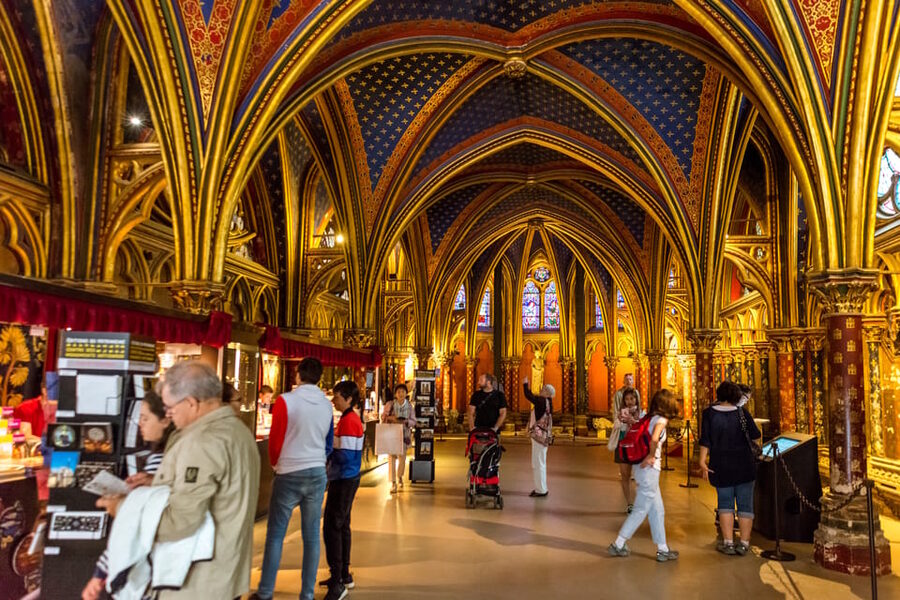
I would visit Sainte-Chapelle first if you want to see its most beautiful feature while your attention is fresh. The lower chapel is attractive, but the upper chapel is what makes this visit special. Once you climb up, the walls seem to dissolve into glass.
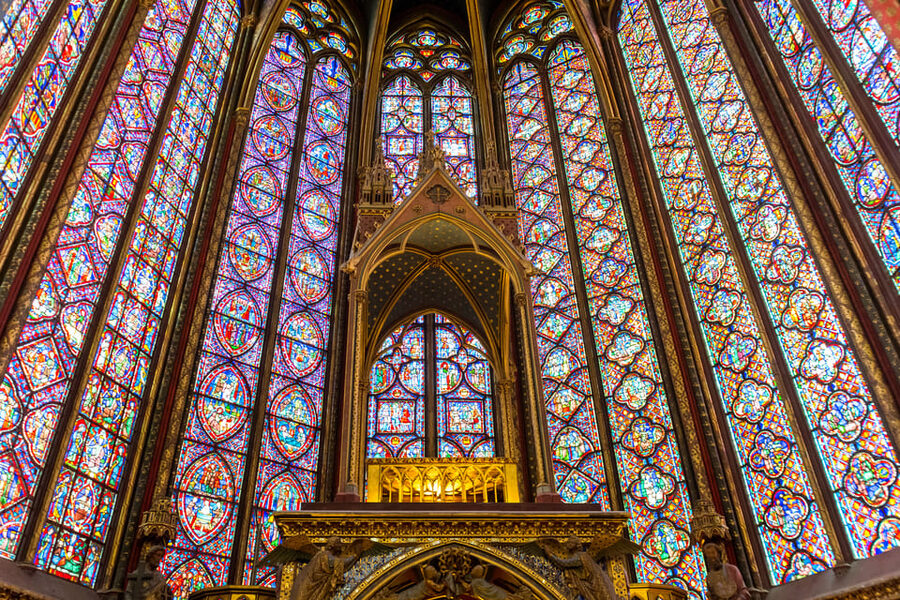
The windows reach high above you, with slim stone supports separating one biblical scene from the next. The color is the point: intense blues, reds, golds, and purples create the feeling of standing inside a jewel box. You need to look slowly, because each panel contains small figures and scenes that are easy to miss when the room is crowded.
This is not a huge church. That is part of its charm, but it also explains why the interior can feel packed. Some people find the visit brief if they only take pictures and leave. I would give yourself at least 45 minutes, and longer if you want to follow the stories in the windows.
The chapel offers guided tours daily from 11 a.m. to 3 p.m., lasting about 45 minutes. However, do not assume your ticket includes a personal guide. The basic experience is entry, with booklets available in English, French, German, Spanish, Italian, Japanese, Polish, Russian, Dutch, Chinese, and Portuguese. An audio guide has also been praised for making the chapel’s design and history easier to follow, but availability of printed English material can vary.
A small detail matters here: seats are limited. If you find one, use it. Looking upward for a long time can tire your neck, and the best way to appreciate the windows is to pause rather than hurry through.
Why the windows deserve your full attention
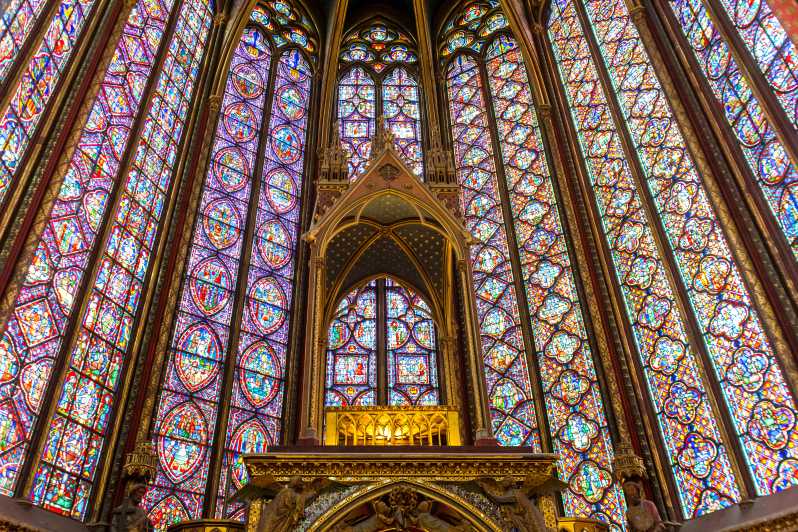
Sainte-Chapelle is often compared with Notre-Dame, but the two offer different experiences. Notre-Dame gives you scale, stone, and the feeling of a great working cathedral. Sainte-Chapelle gives you concentrated color. Several visitors preferred the chapel precisely because its upper room makes such a direct visual impact.
I would not judge the building from the outside alone. From street level, it is easy to miss how dramatic the interior becomes. The stained glass is also difficult to understand from photographs, since pictures flatten the light and cannot show how the colors shift as you move around the room.
Look at the windows in sections instead of trying to absorb everything at once. A booklet or audio guide can help explain what you are seeing. If English material is important to you, check what is available when you arrive, since one visitor found that English pamphlets had run out.
The main drawback is crowding. Lines of 30 to 40 minutes are common enough to plan for, and some people waited close to an hour despite having prepaid tickets. The ticket can still speed up the overall process, especially when direct sales are sold out, but it is not a promise of instant entry.
The Conciergerie: from royal residence to revolutionary prison
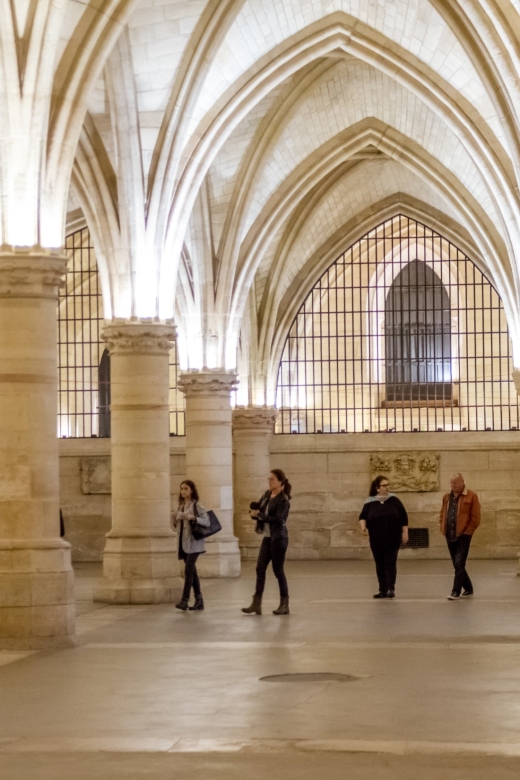
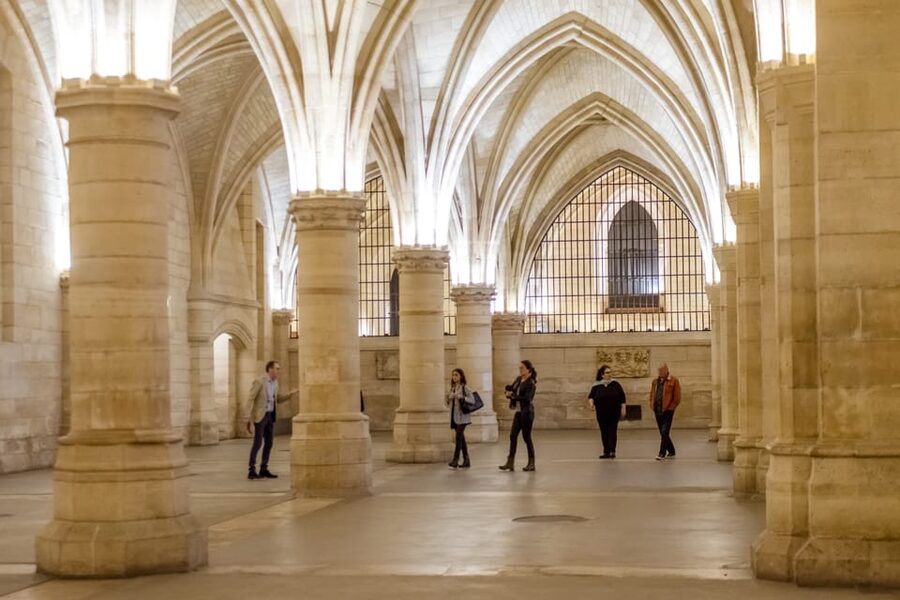
The Conciergerie feels almost like a different attraction. Its medieval rooms are broad, heavy, and stone-built, with far less of Sainte-Chapelle’s visual lightness. This is the place to focus on how the Palais de la Cité changed over time.
The building was once part of the royal residence before becoming a prison. During the French Revolution, it held prisoners awaiting trial, including Marie-Antoinette. You can see prison-related spaces, cells, and displays connected with the revolutionary period.
The Conciergerie will appeal most to you if you enjoy political history and the physical details of old buildings. The cells and prison rooms make the period feel more immediate than a timeline in a museum. The setting also helps explain the fear and uncertainty surrounding revolutionary justice.
I found the contrast with Sainte-Chapelle useful. The chapel shows the power and ceremony of medieval monarchy. The Conciergerie shows the same broad seat of power from a harsher angle, when the building had become associated with imprisonment and the violence of revolution.
That said, some people find the Conciergerie less compelling than the chapel. The displays are more restrained, and the emotional impact depends on how much you want to read and think about the French Revolution. If you only have time for one monument, Sainte-Chapelle is the safer choice for visual impact. If you want context and a more serious historical visit, keep both.
Same city, a slower kind of day:
- Paris: Evening River Cruise with Music
★ 4.4 · 22,721 reviews - Paris: Eiffel Tower Entry Ticket with Optional Summit Access
★ 4.4 · 20,035 reviews - Paris: Eiffel Tower Summit or Second Floor Access
★ 4.3 · 17,248 reviews - Paris: Louvre Guided Tour with Reserved Access & Boat Cruise
★ 4.3 · 16,353 reviews
Marie-Antoinette’s cell and the HistoPad

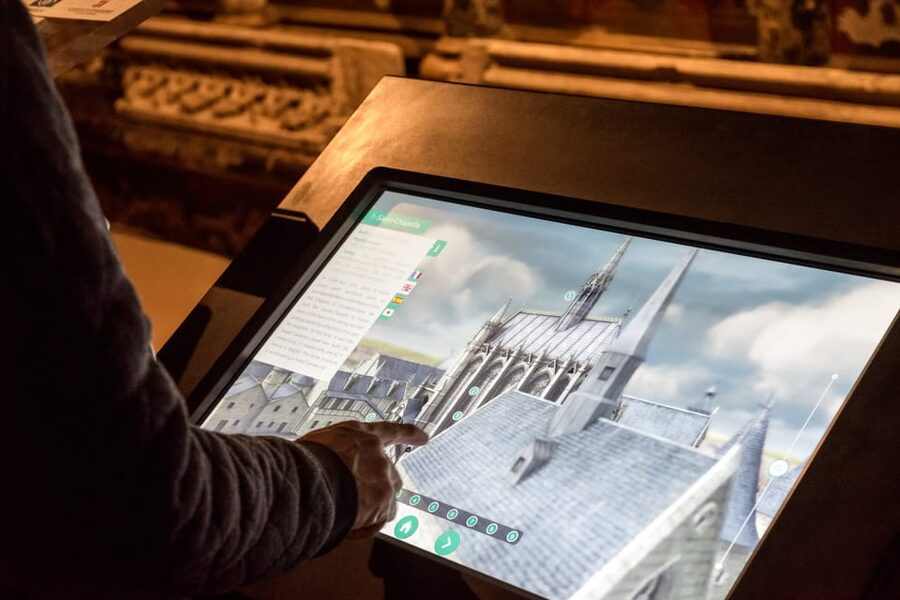
The Conciergerie’s best extra feature is the HistoPad. This digital tablet uses augmented reality, 3D scenes, and interactive functions to show rooms that have disappeared. It also reconstructs Marie-Antoinette’s cell in French, English, German, Spanish, Italian, and Chinese.
I like this tool because empty medieval rooms can be hard to picture. A tablet can show how a space looked in an earlier period, helping you connect the bare stone walls with the people who lived or waited there.
The HistoPad is not equally useful in every section. Some visitors found the content engaging and especially good for children, while others found the audio or tablet guidance confusing. I would treat it as a helpful option, not as a perfect substitute for a guide.
The Conciergerie also has booklets in several languages, including English. Good signage covers much of the visit, so you can still follow the story if the digital material does not suit you.
Allow about an hour for the Conciergerie if you want to read the displays and use the HistoPad. It can take longer if the revolutionary history interests you. One pair spent about two and a half hours at both monuments and still felt rushed near the end because another appointment was waiting.
Queues, security, and finding the entrance
This is where your planning matters most. The Palais de Justice area may require security screening and ID verification. Bring your passport or ID card, and do not arrive assuming the prepaid ticket lets you walk straight inside.
The entry system can be efficient once the line is moving. Some visitors had only a short wait, and advance tickets helped when Sainte-Chapelle had sold out elsewhere. Others still waited 30 minutes, 40 minutes, or close to an hour. Paris crowds, court security, and the narrow entrance all play a part.
I would arrive early, especially on a weekend, public holiday, or during Christmas holidays. On those days, access to the monuments may need to begin through the first listed address rather than the usual route. If you go to the wrong entrance, you can lose valuable time, so check the directions on your ticket before setting out.
The Conciergerie entrance can also be harder to spot than expected. Look carefully around the Palais de la Cité complex instead of assuming both attractions have obvious street doors.
Last entry is 30 minutes before closing. That rule matters because the two sites require more time than their close location suggests. A late afternoon booking may leave you with too little time for both.
Is the $27 price good value?
At $27 per person, this is reasonable if you genuinely want to see both monuments. Sainte-Chapelle alone can justify much of the cost for people who care about Gothic architecture and stained glass. Adding the Conciergerie gives you a second experience without another major stop or separate booking.
The value improves when Sainte-Chapelle is sold out through another sales channel. Several people used this option to secure a last-minute entry time when they could not buy directly. That convenience can matter more than a small price difference during a busy Paris visit.
The value is weaker if you only want a quick look at the chapel. The upper room is not enormous, and some visitors felt the visit offered little beyond the windows. The Conciergerie also may not hold your attention if you are not interested in prison history or the French Revolution.
I would compare the price with official admission before booking, but the practical benefit is clear: one purchase covers both sites and gives you a timed place at Sainte-Chapelle. The separate-line advantage is not guaranteed, yet advance booking can still protect you from a sold-out time slot.
Who should book this Paris experience?
I recommend it for first-time visitors who want two famous Île de la Cité sights in one compact plan. It also suits repeat visitors who have seen Notre-Dame but somehow missed Sainte-Chapelle, a surprisingly common Paris oversight.
Families may appreciate the HistoPad, since the Conciergerie’s reconstructed rooms are easier to understand through pictures and interactive features. Older children who enjoy castles, prisons, or revolutionary stories should have plenty to discuss.
Art and architecture fans should put Sainte-Chapelle high on the list. The upper chapel is the reason to book, and the best visit is a slow one. History fans may find the Conciergerie more rewarding, especially when examining Marie-Antoinette’s cell and the revolutionary displays.
I would hesitate to recommend it to anyone with a very tight schedule. Queues can be long, the buildings can be crowded, and the two visits can easily fill two and a half hours. This is not a quick photo stop unless you are prepared to miss much of what makes the sites worthwhile.
The experience is also not ideal if you expect a full guided tour from start to finish. A 10-person small-group format may apply to the booking arrangement, but the central product is admission to both monuments. Guided tours are available at Sainte-Chapelle during set hours, while the Conciergerie relies more on signage, booklets, and the HistoPad.
Practical plan for a smooth visit
Choose Sainte-Chapelle as your anchor because its entry time is the one you select. Then make sure the Conciergerie visit is scheduled for the same day, rather than assuming the ticket can be used later in your trip.
Bring photo identification. Free admission applies to visitors under 18 and EU citizens under 26 with photo ID, but eligible visitors still need an onsite ticket. The booking instructions also distinguish between non-EEA adult categories and EEA reduced categories, so select the category that matches your status.
The monuments close on January 1, May 1, and December 25. They are free on the first Sunday of January, February, March, November, and December, as well as during European Heritage Days on the third weekend of September. Those free dates may bring heavier demand, so plan with patience.
The ticket is non-refundable. I would not book until your Paris schedule is firm, particularly because the timed Sainte-Chapelle entry and same-day Conciergerie requirement leave less room for last-minute changes.
Should you book the combined ticket?
Yes, if the stained glass of Sainte-Chapelle is high on your Paris list and you have at least two hours to spare. The chapel delivers the unforgettable visual moment, while the Conciergerie adds a sobering look at monarchy, imprisonment, and the French Revolution. At $27, the pairing offers solid value when direct Sainte-Chapelle tickets are unavailable.
Book with realistic expectations. You may still queue, security can be slow, and the ticket does not guarantee a personal guide. If you arrive early, carry ID, allow extra time, and give the upper chapel the attention it deserves, this is one of the strongest short cultural visits on Île de la Cité.
FAQ
Where are Sainte-Chapelle and the Conciergerie located?
Both monuments are at the Palais de la Cité on Île de la Cité, at 2 Boulevard du Palais, 75001 Paris.
How long is the ticket valid?
The combined ticket is valid for one day. You must visit both Sainte-Chapelle and the Conciergerie on the same day.
Do I choose a time for Sainte-Chapelle?
Yes. You select the date and time for Sainte-Chapelle when booking. The Conciergerie visit must take place on the same day at the chosen time.
Does the ticket include a guided tour?
The ticket includes entry to Sainte-Chapelle and the Conciergerie. Sainte-Chapelle offers daily guided tours from 11 a.m. to 3 p.m., lasting 45 minutes, but a personal guide is not guaranteed as part of the admission ticket.
Is the Conciergerie HistoPad available in English?
Yes. The HistoPad’s 3D reconstruction of Marie-Antoinette’s cell is available in French, English, German, Spanish, Italian, and Chinese.
What identification should I bring?
Bring a passport or ID card. Security checks and identity verification may take place near the Palais de Justice.
Who can enter free of charge?
Admission is free for visitors under 18 and EU citizens under 26 with photo ID. These visitors still need an onsite ticket.
When are the monuments closed?
Sainte-Chapelle and the Conciergerie are closed on January 1, May 1, and December 25. Last entry is 30 minutes before closing.
Recently added in France
- Mt St. Michel Private Tour with Abbey tickets and tour guide★ 5.0 · 45 reviews
- Normandy Victory Museum admission ticket★ 5.0 · 58 reviews
- Private Guided Tour in WW2 Jeep of the Landing Beaches★ 5.0 · 110 reviews
- Mont-St-Michel: Private Walking Tour “Abbey Ticket Included”★ 5.0 · 28 reviews
- The Urban Hike of Marseille★ 5.0 · 35 reviews
- Airborne Museum Admission Ticket★ 5.0 · 424 reviews
- From Cherbourg: D-Day Beaches Shore Excursion★ 5.0 · 28 reviews
- Surf school Soonline Moliets★ 4.5 · 27 reviews
Tickets, compared.


Versailles Palace and Gardens Full Access Ticket
Read our review →
Eiffel Tower Entry Ticket with Optional Summit Access
Read our review →
Moulin Rouge Cabaret Show Ticket with Champagne
Read our review →
Montparnasse Tower Observation Deck Entry Ticket
Read our review →
Louvre Museum Entry Ticket With Host and River Cruise
Read our review →