
REVIEW · WALKING TOURS
Historic Paris Walking Tour in English
Paris rewards walkers. This 150-minute tour links major sights with stories of revolution, art, war, religion, and daily life. I like the clear historical sweep and the way guides such as Thomas, Harry, Francesca, and Yazid bring different strengths to the route. The main consideration is simple: you cover a lot of ground, so this is an introduction rather than a slow, detailed visit inside each monument.
I also like the practical starting point at Hotel de Ville and the strong value at $31 per person. You get an English-speaking local guide and a carefully prepared narrative, with no hotel pickup or drop-off. Since this is connected to a pay-as-you-wish format, check the payment terms carefully so you understand what your booking fee covers.
In This Review
- Key points to know before you go
- What this Paris walking tour does well
- Meeting at Hotel de Ville
- Notre-Dame and the medieval heart
- Sainte-Chapelle and the power of medieval Paris
- The Louvre, from royal palace to art museum
- Tuileries Gardens and the art of Parisian space
- Pont des Arts and the Seine connection
- The Eiffel Tower and the city’s modern identity
- Stories of revolution, Napoleon, and occupation
- How much walking and what the pace feels like
- The guides are the heart of the experience
- Is $31 good value?
- Who should book this walk?
- My booking advice
- FAQ
- How long does the Historic Paris Walking Tour last?
- What language is the tour conducted in?
- Where is the meeting point?
- How early should I arrive?
- Does the price include hotel pickup and drop-off?
- Can I cancel the booking for a refund?
Key points to know before you go
- A two-and-a-half-hour introduction: The 150-minute route gives you a broad first look at central Paris without taking an entire day.
- Stories matter here: Expect tales involving Quasimodo, Napoleon, Hitler, love, revenge, and the theft of the Mona Lisa.
- Major sights are viewed from the outside: The Louvre, Notre-Dame, Sainte-Chapelle, the Eiffel Tower, Pont des Arts, and Tuileries Gardens feature in the route, but this is not an interior admission tour.
- Guides receive the strongest praise: Thomas, Harry, Francesca, Yazid, Tom, Victoria, and others are described as warm, funny, engaging, and well informed.
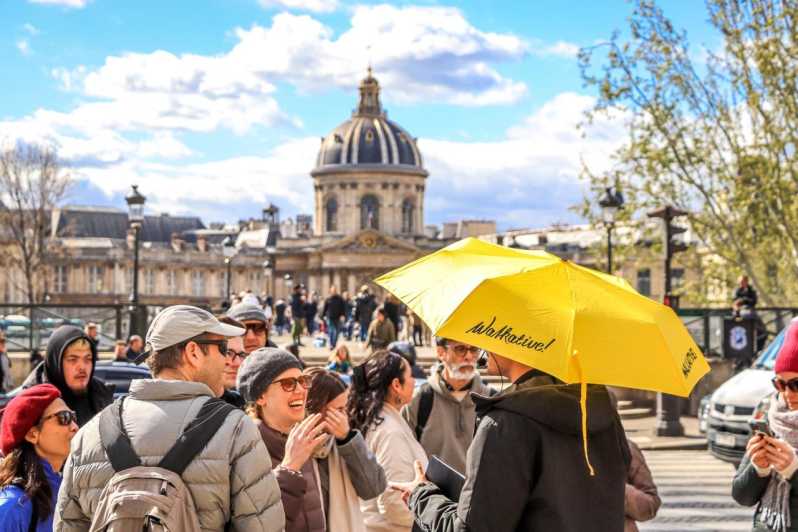
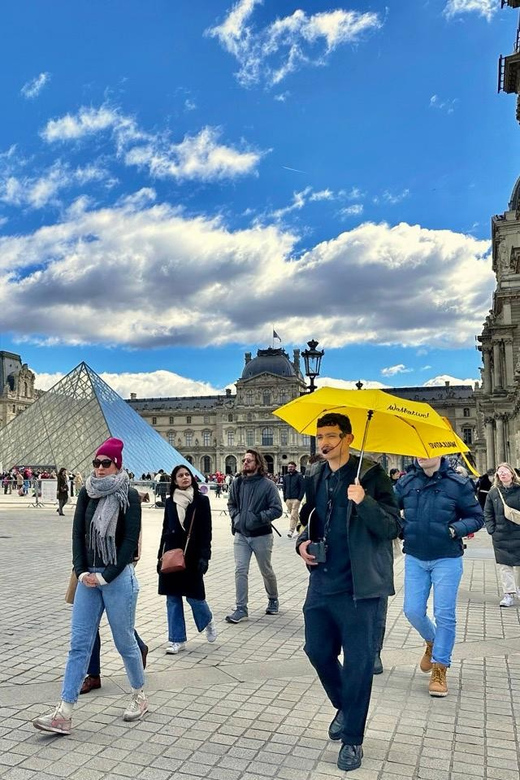
- Easy meeting point: Meet outside the Hotel de Ville metro station at exit 5, under a yellow umbrella.
- Best taken early in your stay: The tour helps you understand Paris before you tackle museums and monuments on your own.
What this Paris walking tour does well
This is a classic orientation walk, but it is not just a parade of postcard views. The route uses central Paris as a lesson in how the city grew from a settlement on the Seine into a royal capital, a religious center, an intellectual hub, and the stage for revolution and modern urban planning.
I like that the story is broad enough for first-time visitors but not limited to dates and royal names. You hear about the Parisii, Roman rule, the rise of the Franks, the Sorbonne, religious conflict, the Enlightenment, the French Revolution, Napoleon, and the rebuilding of Paris in the 19th century.
The guides appear to make a real difference. Tom is praised for answering questions on a crisp February morning. Yazid is described as passionate about art, buildings, and culture. Harry earns credit for strong storytelling, while Francesca is remembered for explaining lesser-known places and keeping the group involved. Thomas is singled out for combining military history and art history with humor.
That range matters. A history-heavy walk can become a lecture. Here, the best guide-led moments seem to turn facts into scenes: Quasimodo at Notre-Dame, Napoleon in the political life of France, and the Mona Lisa theft as a real crime story rather than a museum footnote.
More Historical Tours in Paris
- Paris: Louvre Museum Entry with History of Mona Lisa
★ 3.9 · 2,823 reviews - Paris: Dark History and Ghostly Guided Walking Tour
★ 4.7 · 1,000 reviews - Le Marais/Paris – The Historic, Trendy, Jewish, LGBT district
★ 5.0 · 341 reviews
Meeting at Hotel de Ville
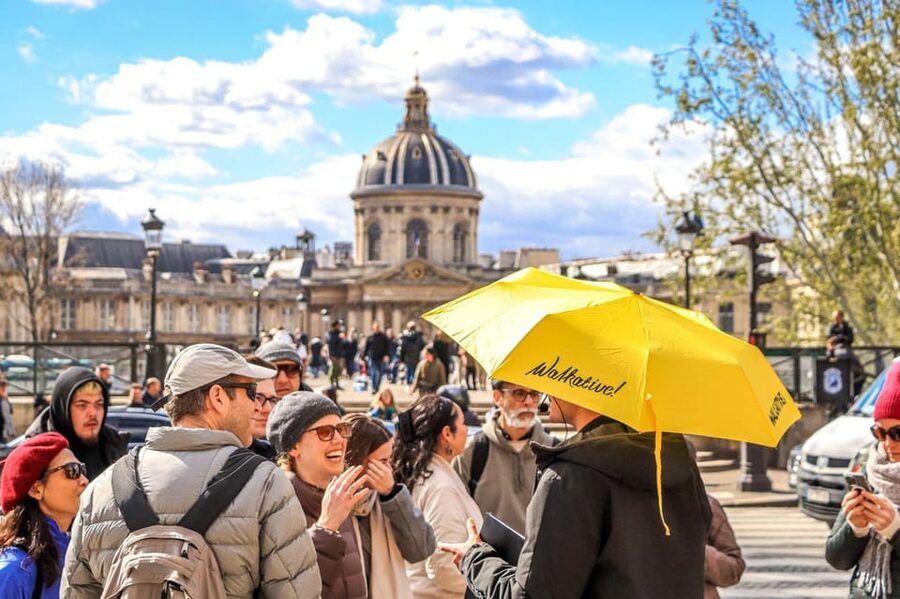
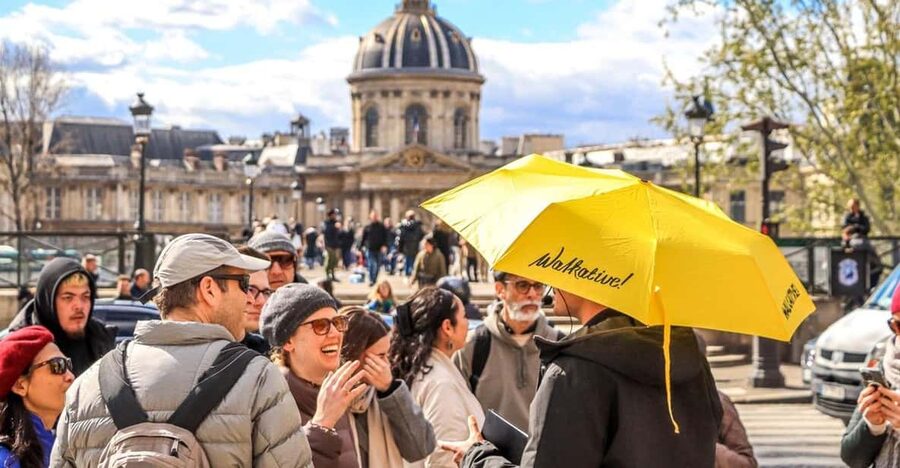
The meeting point is outside the Hotel de Ville metro station at exit 5. Look for the yellow umbrella, and arrive 10 minutes before departure.
This is a sensible place to begin. Hotel de Ville sits beside the Seine and close to the historic core, so you are already near the parts of Paris that shaped the city. It also gives the guide a useful opening: Paris grew around the river, and the river still helps you understand its geography.
You should arrive with a clear plan for the rest of the day. The tour does not include hotel pickup or drop-off, so you make your own way to the meeting point and away from the finish. The exact starting time varies, so check availability when booking.
The meeting point is straightforward, but metro exits in Paris can be confusing. Follow the exit number rather than simply looking for the building. The yellow umbrella is the key visual marker.
Notre-Dame and the medieval heart
Notre-Dame Cathedral is one of the main anchors of the walk. From the outside, you get a sense of why the cathedral has such a powerful place in Parisian identity: it is tied to medieval religion, French history, literature, fire, restoration, and the city’s physical growth around the Seine.
The Quasimodo story adds a literary layer. It connects the building to Victor Hugo’s famous novel and shows how fiction helped shift public attention toward the neglected medieval architecture of Paris. That is a useful lesson in how monuments survive: not only through government money or religious importance, but also through stories people care about.
You should keep your expectations clear. This experience is a walking tour, not a cathedral admission visit. The guide can explain the building and its place in Paris, but you should make separate plans if you want a longer interior visit or access to other parts of the site.
The cathedral is also a good point for understanding the difference between seeing Paris and simply photographing it. A guide can point out how the building relates to the river, nearby streets, and the older city. Without that context, it is easy to treat Notre-Dame as a single famous façade and move on.
Sainte-Chapelle and the power of medieval Paris
Sainte-Chapelle is included among the places you see on the route. Its presence helps broaden the medieval story beyond Notre-Dame.
The chapel represents royal power as much as private devotion. In central Paris, churches and chapels were not isolated religious buildings. They were tied to monarchs, courts, relics, law, and the authority of the French crown.
The tour’s format is especially useful here because it places medieval religious buildings alongside later political spaces. You begin to see that Paris is not one period preserved in stone. Medieval churches, royal institutions, revolutionary memories, and modern boulevards occupy the same compact center.
Again, do not confuse a guided exterior visit with timed admission. If the stained glass and interior architecture are a priority, you will need a separate ticket and more time. The walking tour gives you the explanation first, which can make a later independent visit more meaningful.
More Walking Tours in Paris
- Paris Top Sights Half Day Walking Tour with a Fun Guide
★ 5.0 · 2,893 reviews - Montmartre Hidden Gems and Scenic Highlights Walking Tour
★ 5.0 · 2,684 reviews - Montmartre Hill French Gourmet Food and Wine Tasting Walking Tour
★ 5.0 · 2,588 reviews - Paris Île de la Cité and Notre-Dame Walking Tour With Crypt
★ 5.0 · 2,272 reviews
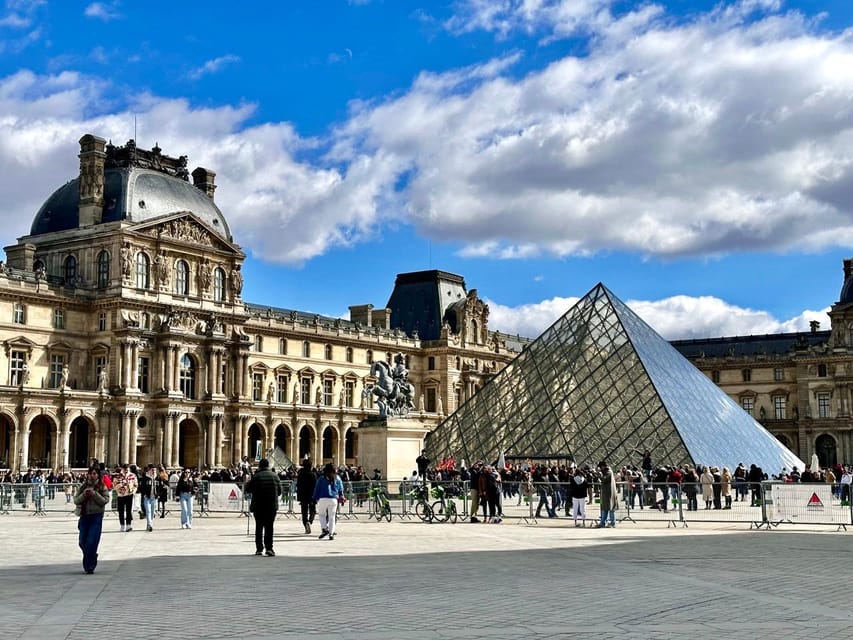
The Louvre, from royal palace to art museum
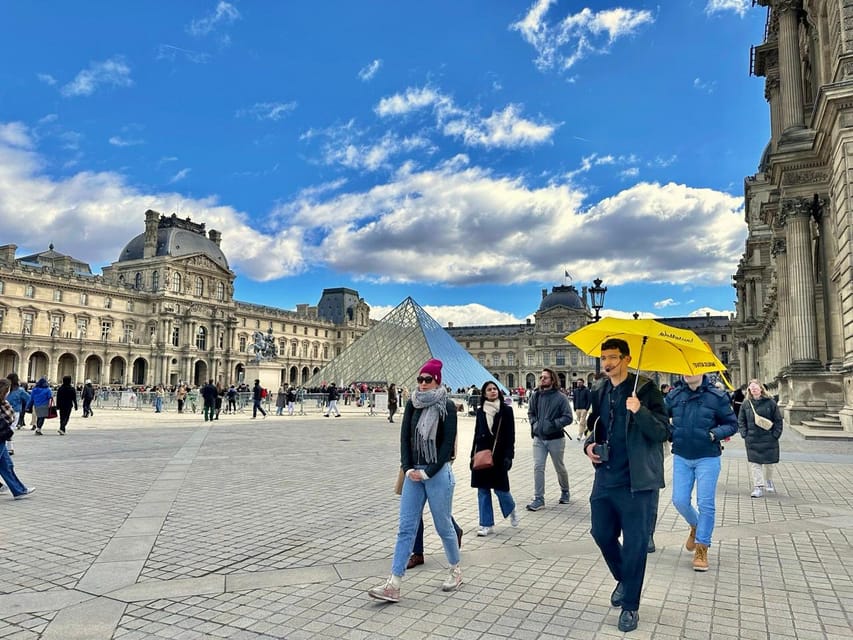
The Louvre receives major attention, and rightly so. Many people know it as the home of the Mona Lisa, but the building began as a royal palace and developed over centuries.
That change in purpose is one of the best themes of the walk. The Louvre lets you trace Paris from monarchy to public culture. A palace built for rulers eventually became a museum where art belongs, at least in principle, to a much wider public.
The Mona Lisa story adds a lively human angle. The tour covers one of the most daring art thefts in history, turning a familiar painting into the center of a crime tale involving the museum and Paris. This is exactly the sort of story that helps you remember the place.
I would not book this tour expecting a museum visit. You see and discuss the Louvre from the route, but the $31 price does not include museum admission. If you want to spend hours with Leonardo, ancient sculpture, or French paintings, reserve a separate Louvre visit. The walk is better viewed as preparation for that larger experience.
It also helps you decide how to use your museum time. After hearing the building’s political and cultural story, you can enter with a better sense of what you are looking at instead of treating the Louvre as an enormous list of famous objects.
Tuileries Gardens and the art of Parisian space
The Tuileries Gardens offer a change of pace from monumental buildings and political drama. They are among the city’s best places to notice how Paris blends formal design with everyday life.
The gardens also fit the larger story of urban power. Royal gardens, public parks, broad avenues, and carefully planned open spaces all played a role in shaping how people moved through the city. The walk links this setting to the major 19th-century rebuilding of Paris.
That rebuilding followed years of unrest. Paris was famous for revolt, and the city was reshaped with wide boulevards, parks, aqueducts, and sewers. The practical reason was public health and movement, but the political reason was also clear: broad streets made barricades harder to build.
This is one of the tour’s most useful ideas because you can see the result around you. Parisian elegance is not only decoration. It is also planning, engineering, power, and control.
The Tuileries are a good place to pause and take in the scale of the route. You can expect city views and explanations rather than a long garden visit. Bring water, wear comfortable shoes, and remember that the weather can change quickly, especially outside the warmer months.
Pont des Arts and the Seine connection
Pont des Arts brings the walk back to the Seine and to Paris as a city of bridges. It is a scenic stop, but the bridge also works as a reminder that Paris developed through movement across the river.
From here, the city’s architecture is easier to read as a connected whole. The river links the Louvre, historic churches, gardens, quays, and central neighborhoods. A walking guide can help you understand why these places were built where they were and how they relate to one another.
Pont des Arts also fits the tour’s romantic side. Paris has long sold itself through love, art, fashion, food, and style. The guide balances that image with stories of inequality, violence, revolution, and political struggle.
That balance is important. You get the postcard Paris, but you also get the difficult Paris. The result is more useful than a tour that only praises the city’s beauty.
The Eiffel Tower and the city’s modern identity
The Eiffel Tower is listed among the sights connected with the tour. Depending on the route and timing, you should treat it as a city landmark discussed or viewed rather than assume a visit to the tower itself.
Its story makes a fine final chapter in Paris’s transformation. Built for the 1889 Universal Exposition, the tower was initially disliked by many Parisians. The structure later became the symbol most associated with the city, which gives the guide a chance to discuss changing taste, technology, and civic identity.
The Eiffel Tower also connects to the 19th-century rebuilding of Paris. It belongs to the era when the city was presenting itself as modern, ambitious, and capable of staging grand international events.
If you want to go up the tower, you will need a separate plan. This walking tour is about understanding the city’s major symbols, not covering their admission procedures or interior spaces.
Stories of revolution, Napoleon, and occupation
The tour’s narrative reaches well beyond architecture. You hear about poverty and inequality, the overthrow of the monarchy, the execution of the king and queen, Napoleon’s rise, and Paris’s role in later European conflict.
The strongest guides seem to keep this material lively. One guide is described as dramatic and funny, another as warm and easygoing, and another as especially good at making art history accessible. That mix is useful if your group includes both serious history fans and people who normally lose interest after the first royal family tree.
The Hitler story adds a 20th-century layer. It places Paris in the difficult history of occupation and war, rather than leaving the city frozen in medieval or revolutionary times.
You should expect interpretation, not an academic seminar. The narrative is designed to keep a group moving and engaged. If you want highly specialized military history or a full course in French politics, this will not replace a book or museum lecture. For a first introduction, though, the range is impressive.
How much walking and what the pace feels like
The experience lasts 150 minutes, which is long enough to cover a meaningful section of central Paris but short enough to fit around a museum booking or evening meal.
One useful detail from the feedback is that the walk was described as good exercise but not strenuous. Another person appreciated that it finished on time. That makes planning easier, especially if you have timed entry to the Louvre, Sainte-Chapelle, or another attraction afterward.
Still, you are on your feet for two and a half hours. Comfortable shoes are a must. The route includes city streets, bridges, public spaces, and gardens, so your attention will be split between listening, walking, and watching for traffic or other pedestrians.
Group size can vary. One group was estimated at fewer than 20 people and never felt like a large, slow-moving crowd. That suggests a manageable format, but no fixed group limit is provided, so I would not assume every departure will be equally small.
The guides are the heart of the experience
The most consistently praised part of this tour is the guiding. Names that receive especially warm attention include Tom, Thomas, Harry, Francesca, Yazid, Toto, and Victoria, along with several others.
The praise is specific. Guides are credited with answering questions, using illustrations, telling stories with feeling, keeping different ages interested, and creating a friendly group atmosphere. Thomas is particularly praised for mixing serious history with humor, while Harry is remembered as a strong storyteller who made the past feel close.
That human element matters because central Paris can be overwhelming. You can see the Louvre, Notre-Dame, the Seine, and the Tuileries on your own. What you cannot easily recreate is the order of ideas that links them together.
The guide also helps you ask better questions later. After this walk, you may look at a palace as a former seat of power, a garden as a political space, or a bridge as part of the city’s social history rather than just another photo stop.
Is $31 good value?
At $31 per person, the price is reasonable for a 150-minute guided introduction, especially if your guide delivers the kind of storytelling and local explanation described above.
The value comes from the structure. You are not paying for admission to the Louvre, Notre-Dame, Sainte-Chapelle, or the Eiffel Tower. You are paying for an organized route and a guide who connects those places into one story.
That distinction is important. If you want monument interiors, the cost of separate tickets will add up. If you want to get your bearings, understand the major sights, and avoid spending your first day wandering without context, the price makes good sense.
The booking arrangement deserves attention. The tour is part of a general pay-as-you-wish format, while this booking price covers the reservation fee and the guide’s payment. Read the terms at checkout so you know how the payment is handled.
Free cancellation is available up to 24 hours before the activity for a full refund, and you can reserve now and pay later. Those options help if your Paris schedule is still shifting.
Who should book this walk?
I would recommend it most strongly for a first visit to Paris, a solo visitor who wants an easy social activity, or anyone who likes history explained through stories rather than lists of dates.
It also suits mixed groups. One guide was praised for making the walk work for serious history fans and people with only a passing interest. That is a valuable quality when one person wants revolution and military history while another wants art, architecture, and food.
Families with older children may also find the approach useful, especially if the guide uses humor and visual material. The 150-minute length gives you substance without committing to a full day.
You may want something else if you dislike group walking, need a very slow pace, or want extended time inside museums and churches. This is a lively overview, not a private tour or a specialist art lecture.
My booking advice
Take this tour early in your Paris stay if you can. The route gives you a working map of the historic center and helps you choose where to return for a longer visit.
Arrive 10 minutes early at Hotel de Ville metro exit 5, look for the yellow umbrella, and wear shoes suited to a long city walk. Keep the rest of your day flexible enough to stop for food, a museum, or a return visit to a site that catches your attention.
I would book it for the guide-led history, the strong mix of famous sights and political stories, and the sensible price. I would skip it only if your priority is entering every monument or exploring one subject in great depth. For a first look at Paris, it offers a useful route, lively storytelling, and enough context to make the city easier to understand.
FAQ
How long does the Historic Paris Walking Tour last?
The tour lasts 150 minutes, or two and a half hours.
What language is the tour conducted in?
The live tour guide leads the experience in English.
Where is the meeting point?
Meet outside the Hotel de Ville metro station at exit 5. Look for a yellow umbrella.
How early should I arrive?
You should arrive at the meeting point 10 minutes before the activity begins.
Does the price include hotel pickup and drop-off?
No. Hotel pickup and drop-off are not included.
Can I cancel the booking for a refund?
Yes. You can cancel up to 24 hours in advance for a full refund. You can also reserve now and pay later.
Recently added in Paris
- Private Transfers in Paris★ 5.0 · 75 reviews
- CDG – Euro Disney – CDG Two Way Private Shuttle Transfer★ 5.0 · 233 reviews
- Disneyland® Paris 1 Day Ticket with Transport from Paris★ 3.5 · 302 reviews
- Personalized Transport service from Disneyland to Paris★ 5.0 · 63 reviews
- Monet’s Gardens & House-Private Giverny Tour From Paris★ 4.5 · 137 reviews
- Guided tour Monet’s house and gardens/small group★ 4.5 · 68 reviews
- Giverny Monet House and Gardens Skip the line Walking tour★ 4.0 · 217 reviews
- Monet’s House and Garden & Giverny Village★ 4.5 · 39 reviews
Walking Tours, compared.

Paris Top Sights Half Day Walking Tour with a Fun Guide
Read our review →
Montmartre Hidden Gems and Scenic Highlights Walking Tour
Read our review →
Montmartre Hill French Gourmet Food and Wine Tasting Walking Tour
Read our review →
Paris Île de la Cité and Notre-Dame Walking Tour With Crypt
Read our review →
Montmartre Cheese, Wine & Pastry Guided Walking Tour
Read our review →
Paris in a Day: Louvre or Orsay, Eiffel Tower, City Walk & Cruise
Read our review →
Montmartre Highlights Walking Tour with a Local Guide
Read our review →
Paris City Center Free Walking Tour (Tip-Based)
Read our review →Browse the lists this tour appears in