
REVIEW · LE MARAIS WALKING TOURS
Paris Marais Quarter 2-Hour Private Walking Tour
The Marais keeps changing its story. This private two-hour walk links medieval Paris, Jewish heritage, royal grandeur, and modern art in one compact outing. I like the private format, which lets your guide shape the pace, and I like the route’s unusual range, from Les Halles to Place des Vosges. The main drawback is simple: two hours passes quickly, so expect highlights rather than a full study of every street and building.
The tour begins at Metro Étienne Marcel, where you look for a red canvas tote bag. Guides speak English, French, or Serbo-Croatian, and past guests have praised Alexander, Caroline, Boris, Fabienne, Yvana, Anja, and Alexandre for clear explanations, warm personalities, and the ability to adjust their talk to different ages.
In This Review
- Key points to know before you book
- Why the Marais makes such a good walking tour
- Starting at Étienne Marcel and the old Les Halles
- The Centre Pompidou and the medieval city beside it
- Hôtel de Ville and the ceremonial face of Paris
- Entering the Pletzl, the heart of Jewish Paris
- Hôtel de Sully and the road to Place des Vosges
- Reaching Place de la Bastille and the Marais’s harder chapters
- What the private format adds
- Is $176 per person good value?
- Timing, weather, and practical planning
- Who should book this Marais walk?
- Should you book the Paris Marais Quarter tour?
- FAQ
- How long is the Paris Marais Quarter walking tour?
- Where does the tour meet?
- Is this a private tour?
- What languages are available?
- What places are included on the walk?
- Does the tour include food or drinks?
- Does the tour operate in bad weather?
- What does the tour cost?
- Can I cancel for a refund?
Key points to know before you book
- A private walk through several eras: The route connects the Middle Ages, royal Paris, Jewish Paris, the French Revolution, and the modern Centre Pompidou.
- Les Halles opens the story: The former market district shows how food, trade, and urban life shaped central Paris.
- Pletzl gives the tour its human center: You visit the historic Jewish quarter, including Rue Pavée and its synagogue.
- Place des Vosges is the visual high point: This carefully planned square offers some of the Marais’s finest architecture.
- The price buys personal attention: At $176 per person, the tour is costly for a two-hour walk, but the private group format can make sense for families or small groups.
- Plan for weather: The walk operates rain or shine, so comfortable shoes and suitable clothing matter.
Why the Marais makes such a good walking tour
Paris has grand monuments that explain themselves. The Marais needs a guide.
Its name comes from the French word for marsh. The area began as wet ground, then was drained and made habitable. Settlers arrived, streets formed, and the quarter took on new roles over the centuries. It became an important center of Jewish life, later attracted aristocrats and the royal court, then suffered a long decline into a rougher and less fashionable district.
Today, the Marais is enjoying another period of renewal. That does not erase the older layers. Instead, you see them pressed together on the same walk: medieval street patterns, elegant town houses, Jewish institutions, modern shops, public squares, and the bold structure of the Centre Pompidou.
That mixture is the tour’s real strength. You are not simply moving from one pretty building to the next. Your guide helps explain why the neighborhood changed, who lived there, and how Paris repeatedly rebuilt itself.
More Walking Tours in Paris
- Paris Top Sights Half Day Walking Tour with a Fun Guide
★ 5.0 · 2,893 reviews - Montmartre Hidden Gems and Scenic Highlights Walking Tour
★ 5.0 · 2,684 reviews - Montmartre Hill French Gourmet Food and Wine Tasting Walking Tour
★ 5.0 · 2,588 reviews
Starting at Étienne Marcel and the old Les Halles
Your meeting point is Metro Étienne Marcel. Look for the guide carrying a red canvas tote bag, a useful detail in a busy part of the city.
From here, the walk reaches Les Halles, once the biggest open market in Paris. The market was more than a place to buy food. It was a major engine of daily life, bringing merchants, workers, shoppers, and supplies into the center of the city.
The value of seeing Les Halles early is that it gives you a social starting point. Paris was not shaped only by kings and monuments. Markets mattered just as much. They fed the city, created jobs, and helped make this part of Paris a place where many kinds of people crossed paths.
Your guide also points out the Fontaine des Innocents. This fountain is a reminder that public spaces in Paris often have several lives. A monument may begin with one purpose, then take on another meaning as the surrounding streets change.
Do not expect a long stop at every site. Two hours is enough for an engaging overview, not a slow architectural survey. If Les Halles or the fountain is especially important to you, tell your guide early so the private format can work in your favor.
The Centre Pompidou and the medieval city beside it
The Centre Pompidou brings an unmistakably modern note to the route. Its bold design can seem to belong to another city altogether, especially when placed beside older buildings and medieval traces.
That contrast is exactly why it earns a place on this walk. Your guide explains the connection between the Middle Ages and the modern art center, helping you see that the Marais is not a frozen historic district. New Paris has been built directly beside old Paris, sometimes awkwardly, sometimes brilliantly.
I like this part because it challenges the easy idea that historic neighborhoods should look old from end to end. The Marais works better when you notice the friction. Stone streets, old religious and civic buildings, and the Centre Pompidou’s modern form all tell you that the city keeps making choices about what to preserve and what to replace.
You will not enter the Centre Pompidou on this tour. The experience is a guided walk through the surrounding quarter, with the building used as part of the area’s larger story.
Hôtel de Ville and the ceremonial face of Paris
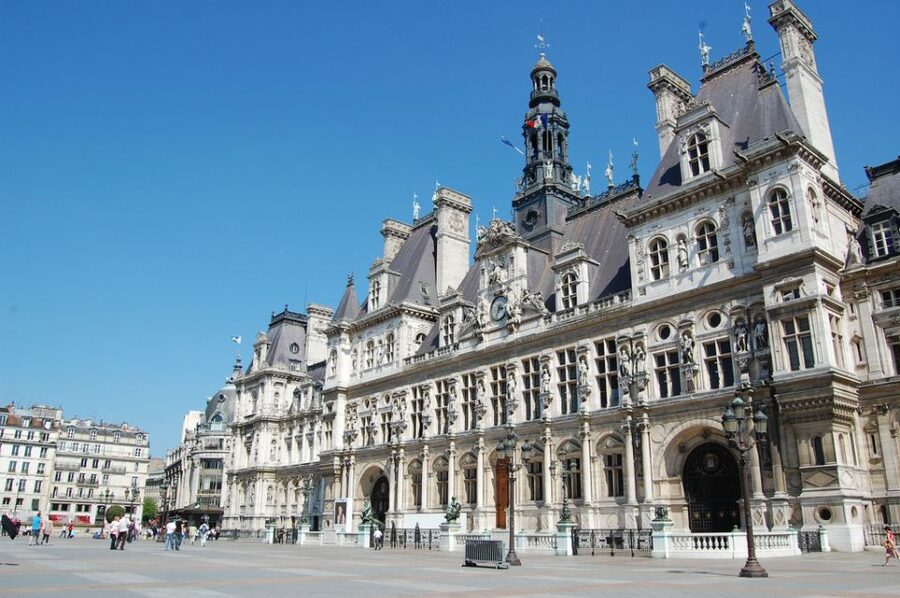
The route continues to Hôtel de Ville, the city hall. Its opulent Renaissance style gives you a look at the formal, civic side of Paris.
This is a useful pause in the walk because it shifts attention from neighborhood streets to city power. A city hall is not just an attractive façade. It represents administration, public authority, and the political life of the capital.
Your guide can help connect the building to the wider story of Paris, rather than leaving it as a quick photo stop. That context matters, especially if you are seeing the building after the informal streets of Les Halles and before the more personal story of the Pletzl.
The square around Hôtel de Ville also helps you understand the scale of central Paris. You are walking through places where public life, government, commerce, and ceremony have long met. Expect a strong visual stop, but keep your attention on the explanation as well as the architecture.
More walks through Le Marais:
- Award-Winning Paris French Bakery Experience — Le Marais, 4th Arr
★ 4.5 · 1,186 reviews - Paris Le Marais Food Tour With 10+ Tastings, Cheese, Wine & More
★ 5.0 · 985 reviews - Paris Le Marais District Original Food and Wine Tasting Tour
★ 4.5 · 880 reviews - Paris Bike Tour Hidden Secrets in the Latin Quarter & Le Marais neighborhoods
★ 5.0 · 766 reviews
Entering the Pletzl, the heart of Jewish Paris
The Pletzl is one of the most meaningful sections of the walk. The name refers to the small square or little place, and the area became the historic center of the Jewish community in Paris.
Here, the tour moves from broad urban history to the story of a particular community. That change gives the route emotional weight. You learn how the Marais served as a place of Jewish life and how that identity remains present today.
Rue Pavée and its synagogue are key stops. The street is not simply an attractive old lane. It represents continuity, memory, and the way a community can shape a neighborhood over generations.
This is also where a good guide matters most. Names, dates, and architectural labels can only take you so far. The best explanations connect buildings to people and daily life. Past guide feedback gives this tour a strong record on that point. Alexander was praised for tying the history of Paris and the Marais together, while Fabienne was noted for making her explanations clear and suited to her audience.
If you are walking with children or a mixed-age family, this section may be particularly useful. Alexandre received praise for working well with a group ranging from age six to 75, suggesting that the tour can adjust its level instead of speaking only to serious history fans.
Hôtel de Sully and the road to Place des Vosges
Hôtel de Sully introduces the refined side of the Marais. This grand residence reflects the era when the neighborhood attracted wealthy families, aristocrats, and people close to the royal court.
The building helps explain the Marais’s earlier reputation as a fashionable address. The district’s grand houses were not accidental decorations. They show how status, money, and access to power once shaped where Paris’s elite lived.
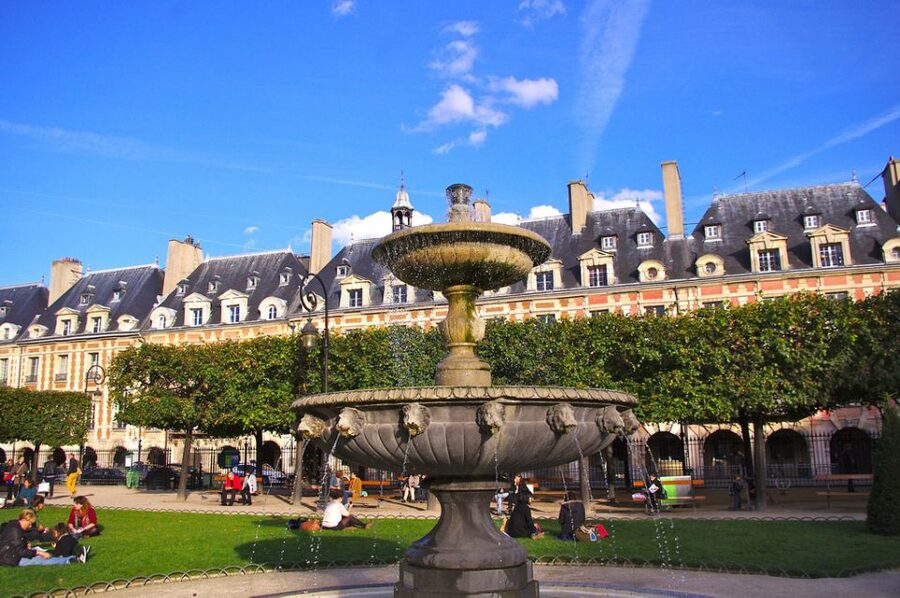
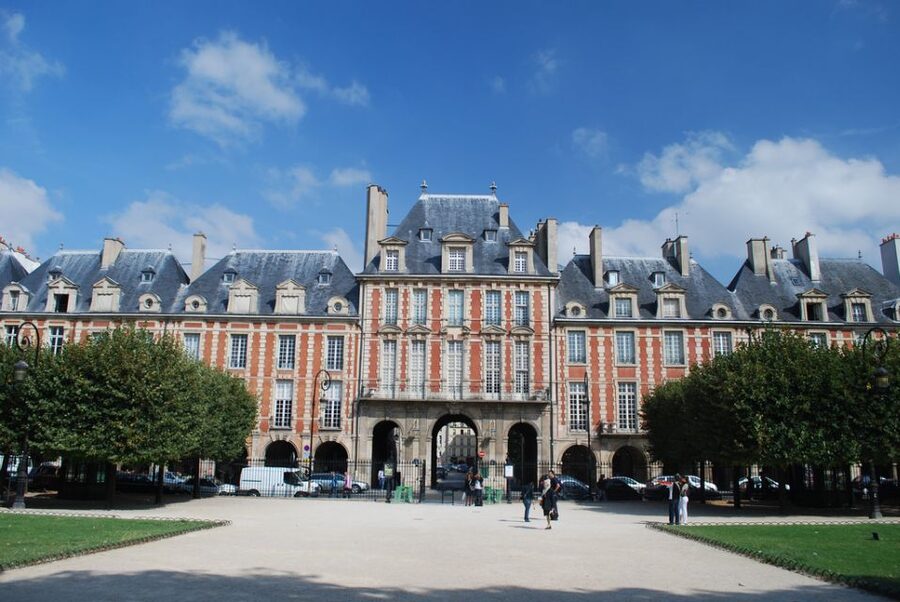
From here, the route reaches Place des Vosges, often counted among the most beautiful squares in the world. Its regular layout and harmonious façades make it one of the clearest examples of planned urban design in the Marais.
Place des Vosges is the likely visual high point of the tour. It gives you space to pause after narrower streets and absorb the order of the buildings around the square. The setting is elegant without needing much explanation, but the guide adds useful context about the people and period connected with it.
This is a good place to slow down, take photographs, and ask questions. A private tour gives you a better chance to do that than a large group walk, where the guide must keep everyone moving at the same pace.
Reaching Place de la Bastille and the Marais’s harder chapters
The walk includes Place de la Bastille, one of the major symbols of revolutionary Paris. Its presence reminds you that the Marais was not only a district of markets, mansions, and religious life. It also sat close to moments of violent political change.
The exact emphasis can depend on your guide and the pace of the group. Since the tour lasts two hours and includes many stops, you should expect the Bastille to form part of the larger story rather than receive a long, specialized lecture.
That broad approach suits first-time visitors who want orientation. It may disappoint you if you already know Paris well and want a detailed study of revolutionary events or the architecture of one particular building.
The Marais’s decline is another important part of the route. After its aristocratic period, the area lost status and gained a reputation as a place to avoid. Knowing this makes the present-day quarter easier to understand. Its fashionable cafés, shops, cultural sites, and restored residences are part of a second renaissance, not evidence that the district has always been polished.
What the private format adds
A private group is the key feature here. You are not following a standard-size crowd or listening to a script designed for every possible audience. You can ask about Jewish history, architecture, royal Paris, food markets, modern art, or the daily life of the neighborhood.
The format should suit families, couples, and small groups with different interests. It is also helpful if you want a guide to adjust explanations for children or older adults. Past feedback specifically praised clear, engaging delivery and guides who paid attention to the people in the group.
The language choices are English, French, and Serbo-Croatian. English-speaking visitors have had especially strong guide experiences with Alexander, Caroline, Boris, and Anja, while French-speaking groups praised Alexandre, Fabienne, and Yvana.
Guide assignments can vary, so you should not book on the assumption that you will receive one particular person. Still, the range of praised names suggests that the provider has several guides who can handle both historical detail and a friendly conversation.
Is $176 per person good value?
At $176 per person, this is not a cheap way to spend two hours in Paris. You pay for a private guide, not admission tickets, food, snacks, or drinks. If you are alone or traveling as a couple, the price may feel steep beside a group walking tour.
The calculation looks better for a small private party that values personal attention. A family with children, a group with mixed interests, or people who want to ask many questions can get more from this format than from a fixed group walk.
The tour also saves you from piecing together several neighborhoods on your own. Les Halles, Hôtel de Ville, the Pletzl, Hôtel de Sully, Place des Vosges, and Bastille each have a different character. A guide gives those stops a shared thread.
The provider has also been selected among the top 10 small tour operators in Europe from 26,000 companies. That recognition does not guarantee a perfect personal experience, but it adds some confidence when you are paying a premium for a small operator.
I would view the price as worthwhile if you care about interpretation and conversation. If you mainly want photographs of Place des Vosges or the Centre Pompidou, you can see those areas on your own for far less.
Timing, weather, and practical planning
The walk lasts two hours, with starting times available according to the schedule you select. That length works well as a first introduction to the Marais, especially early in a Paris stay when you want to get your bearings.
It is not long enough to explore every street or enter every site. Wear comfortable shoes, arrive at Metro Étienne Marcel with enough time to identify the red tote bag, and bring clothing suitable for the forecast.
Tours operate rain or shine. Paris rain can turn a pleasant walking route into a tiring one, so do not treat this as an indoor backup plan. A light rain layer and sensible footwear will make the experience easier.
Food and drinks are not included. That is no major problem in the Marais, where you can arrange a meal or snack before or after the walk, but you should plan your own refreshment stop.
Free cancellation is available up to 24 hours before the tour for a full refund. You can also reserve now and pay later, which helps if your Paris schedule is still shifting.
Who should book this Marais walk?
I would recommend it to first-time visitors who want more than a list of monuments. The route gives you a useful map of the Marais and explains why the neighborhood feels so different from one street to the next.
Families may appreciate the private format and the guide’s ability to adapt the talk. The positive experience with a group aged six to 75 is a good sign for a multigenerational outing.
It also suits anyone with a particular interest in Jewish Paris, royal residences, urban change, or the contrast between old streets and modern architecture. Tell your guide what matters to you so the conversation can go beyond the basic route.
I would hesitate if you dislike walking, need a seated tour, or want long visits inside museums and historic buildings. This is an outdoor overview, and the pace must cover many locations in a short time.
Should you book the Paris Marais Quarter tour?
Book this tour if you want the Marais explained as a living neighborhood, not just presented as a collection of attractive façades. The private setting, strong guide record, and wide historical range give it real value for families and small groups.
Skip it if $176 per person feels too high for two hours or if you prefer exploring independently. For most visitors who want clear context, personal questions, and a route that links Les Halles, the Pletzl, Place des Vosges, and Bastille, this is a thoughtful and efficient introduction to one of Paris’s most layered quarters.
FAQ
How long is the Paris Marais Quarter walking tour?
The tour lasts two hours.
Where does the tour meet?
The meeting point is at Metro Étienne Marcel. Your guide will carry a red canvas tote bag.
Is this a private tour?
Yes. The activity is offered for a private group.
What languages are available?
Guides speak English, French, or Serbo-Croatian.
What places are included on the walk?
The route includes Les Halles, Fontaine des Innocents, Centre Pompidou, Hôtel de Ville, the Pletzl area, the synagogue on Rue Pavée, Hôtel de Sully, Place des Vosges, and Place de la Bastille.
Does the tour include food or drinks?
No. Food, snacks, and beverages are not included.
Does the tour operate in bad weather?
Yes. Tours operate rain or shine.
What does the tour cost?
The listed price is $176 per person.
Can I cancel for a refund?
Yes. You can cancel up to 24 hours in advance for a full refund. You can also reserve now and pay later.
More Two-Hour Slots in Paris
- The Père Lachaise Cemetery: Guided 2-Hour Small-Group Tour
★ 4.7 · 1,065 reviews - Paris: 2-Hour Perfume Creation Workshop
★ 4.8 · 731 reviews - Paris Louvre: 2-Hour Private Tour for Groups or Families
★ 4.6 · 639 reviews - Paris Montmartre: 2-Hour City Tour in German
★ 4.9 · 299 reviews
Recently added in Paris
- Private Transfers in Paris★ 5.0 · 75 reviews
- CDG – Euro Disney – CDG Two Way Private Shuttle Transfer★ 5.0 · 233 reviews
- Disneyland® Paris 1 Day Ticket with Transport from Paris★ 3.5 · 302 reviews
- Personalized Transport service from Disneyland to Paris★ 5.0 · 63 reviews
- Monet’s Gardens & House-Private Giverny Tour From Paris★ 4.5 · 137 reviews
- Guided tour Monet’s house and gardens/small group★ 4.5 · 68 reviews
- Giverny Monet House and Gardens Skip the line Walking tour★ 4.0 · 217 reviews
- Monet’s House and Garden & Giverny Village★ 4.5 · 39 reviews
Le Marais Walking Tours, compared.

Award-Winning Paris French Bakery Experience — Le Marais, 4th Arr
Read our review →
Paris Le Marais Food Tour With 10+ Tastings, Cheese, Wine & More
Read our review →
Paris Le Marais District Original Food and Wine Tasting Tour
Read our review →
Paris Bike Tour Hidden Secrets in the Latin Quarter & Le Marais neighborhoods
Read our review →
Food and Wine Tasting Walking Tour in Le Marais
Read our review →
Le Marais/Paris – The Historic, Trendy, Jewish, LGBT district
Read our review →

Browse the lists this tour appears in