
REVIEW · WALKING TOURS
Marseille: Half-Day City Highlights Guided Walking Tour
Marseille rewards anyone willing to walk uphill. This four-hour outing gives you a broad look at the city, from the harbor and old quarters to sea views and local streets. I like the small group of no more than eight people, and I like the way Charles connects history with everyday Marseille. The catch is clear: this is a 9-kilometer walk with hills, steps, and uneven streets.
Charles is the heart of the experience. His energy, humor, and love for Marseille come through in the way he remembers names, checks everyone’s pace, and brings old stories to life. I also like that you do not simply circle the main sights by vehicle. You reach narrow streets and viewpoints that make more sense on foot.
Come prepared with hiking shoes, water, sun protection, and food for your backpack. The tour is not suitable for children under 12, wheelchair users, people with low fitness, or people over 70 according to the stated restrictions, though one 74-year-old participant reported enjoying it. That contrast tells you the real issue is walking ability, not age alone.
In This Review
- Key points to know before you book
- Starting at La Major, Marseille’s grand waterfront gateway
- Le Panier, where Marseille feels most personal
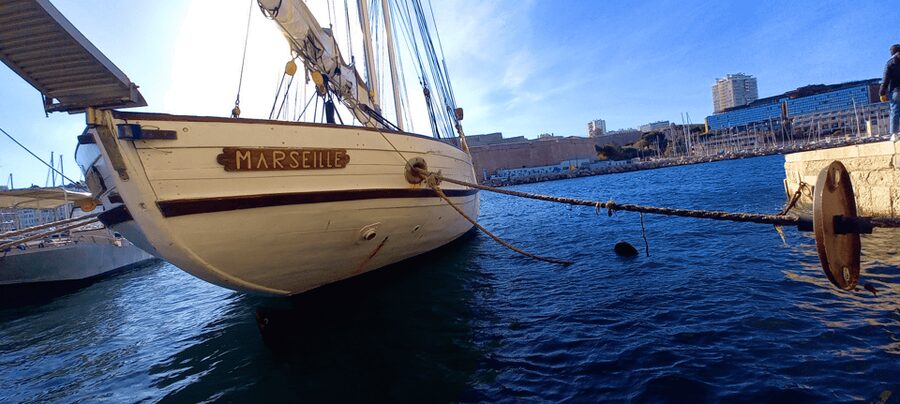
- From Hôtel de Ville to the Old Port by ferry
- Cours Honoré d’Estienne d’Orves and the climb toward Notre Dame
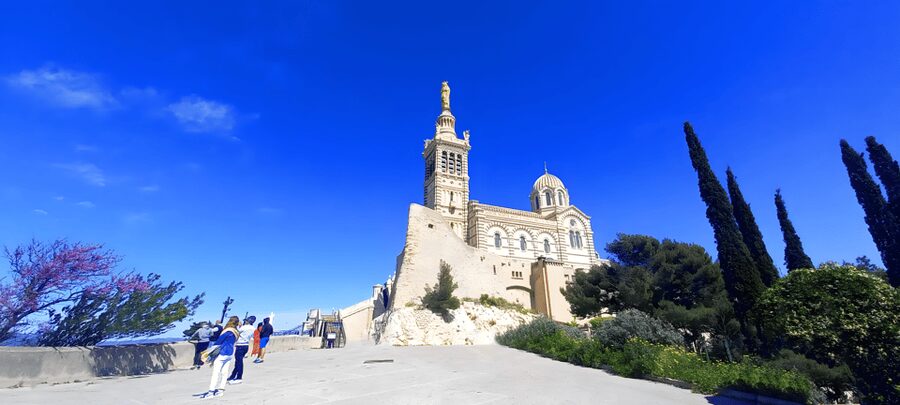
- Notre Dame de la Garde, the tour’s great reward
- Roucas Blanc and the city beyond the center
- Vallon des Auffes, a fishing port in a rocky cove
- Corniche Kennedy, Catalans Beach, and Palais du Pharo
- Saint-Victor Abbey and the finish at the Old Port
- Why Charles makes the difference
- Is $58 a fair price?
- Who should book this Marseille walk?
- Final verdict: a strong introduction for active visitors
- FAQ
- How long is the Marseille walking tour?
- Where does the tour meet?
- Where does the tour finish?
- Which languages does the guide speak?
- How many people are in the group?
- Is food or drink included?
- What should I bring?
- Is the tour suitable for people with limited mobility?
Key points to know before you book
- Nine kilometers in four hours: This is a serious city walk, not a gentle stroll between nearby monuments.
- Charles leads the group: He speaks English and French and is praised for his humor, personal attention, and strong command of Marseille’s past.
- A rare mix of neighborhoods: You move from La Major and Le Panier to the Old Port, Roucas Blanc, Vallon des Auffes, and Saint-Victor.
- Notre Dame de la Garde is the high point: You get time to see the basilica and enjoy wide views over Marseille and the sea.
- A five-minute ferry ride adds variety: The short boat crossing breaks up the walking and gives you a different angle on the harbor.
- Best for first-time visitors: You cover enough ground to understand how Marseille’s districts fit together, then return to places that caught your interest.
Starting at La Major, Marseille’s grand waterfront gateway
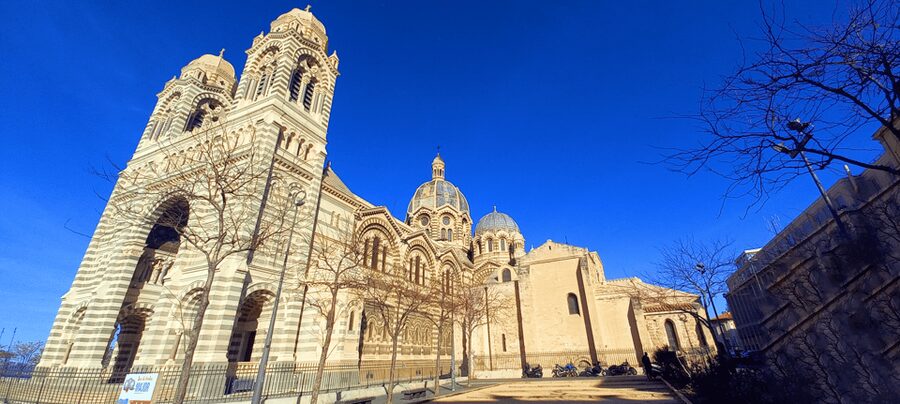
Meet your guide in front of Cathédrale Basilique Sainte-Marie-Majeure, usually called La Major. Look for Charles in a white cap. This is a practical meeting point near the waterfront, and it puts you right beside one of Marseille’s most striking buildings.
The cathedral visit is brief, about 10 minutes, so expect an introduction rather than a long interior tour. La Major gives you an immediate sense of Marseille’s scale and character: grand architecture, a working port nearby, and old neighborhoods rising behind it.
From here, you begin on foot. The route uses pedestrian streets and passages that cars cannot reach. That matters in Marseille, where the change from a broad harbor promenade to a tight old lane can happen within a few steps.
More Walking Tours in Marseille
- Marseille: No-Diet Club Local Food Tasting and Walking Tour
★ 4.8 · 173 reviews - Marseille: Essential Guided Walking Tour of the City
★ 4.9 · 161 reviews - Marseille: Walking Food Tour with Full Meal
★ 4.7 · 137 reviews
Le Panier, where Marseille feels most personal
The walk through Le Panier lasts about 40 minutes. This is one of the best parts of the route for getting a feel for the city beyond its postcard sights.
Le Panier is Marseille’s old quarter, with narrow streets, stairways, older buildings, and a strong neighborhood identity. Charles uses the area to explain how Marseille developed over time, not just as an ancient port but as a city shaped by migration, trade, changing districts, and daily life.
I appreciate the time allowed here. A rushed pass through Le Panier would give you photographs but little understanding. Forty minutes gives Charles room to point out details, share local stories, and guide you through streets you might skip if you were following a standard map.
You should also expect some uphill and downhill walking. The lanes are pedestrian-friendly, but that does not mean they are flat or effortless. Comfortable shoes make a real difference.
From Hôtel de Ville to the Old Port by ferry
The route continues toward Hôtel de Ville, where you spend roughly 10 minutes with Charles. This section links the old quarter with the harbor and helps you see Marseille as a city built around the water.
A short ferry trip follows. The boat ride lasts only about five minutes, but it is a welcome change of pace. You are still on an active sightseeing route, yet the harbor looks different from the water. The ferry also saves your legs for the hills ahead.
You then reach the Old Port, or Vieux Port. This is Marseille’s central stage, lined with boats, cafés, and historic connections to the city’s maritime life. The stop itself is short, about five minutes, but Charles’s explanation helps place the port in the wider story of Marseille.
Do not expect a long free period here. The point is orientation, not shopping or a leisurely coffee. If the Old Port interests you, save time after the tour to return at your own pace.
Cours Honoré d’Estienne d’Orves and the climb toward Notre Dame
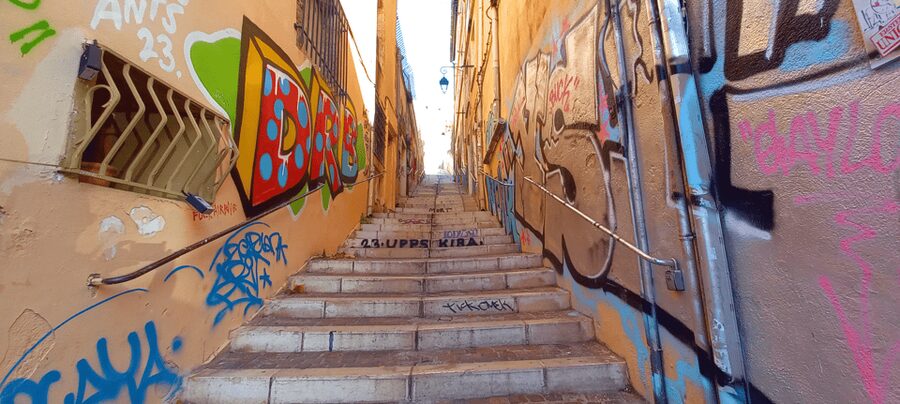
At Cours Honoré d’Estienne d’Orves, Charles continues the story of the waterfront and the city center. You spend about 10 minutes here before heading toward Parc de La Colline Puget.
The park section lasts approximately 25 minutes and signals the tour’s main physical challenge. You begin gaining height, with streets and paths leading toward Notre Dame de la Garde. This is where the tour shifts from urban history to broad views and open air.
A useful point: the route is not designed for people who want to avoid hills. Several people who loved the tour also described it as a long walk with plenty of steps. The pace is generally manageable, and Charles has been praised for slowing down when needed, but you still need enough stamina to keep moving for four hours.
If you need to pause, the instructions allow you to stop and rejoin the group at another location. That provides some flexibility, though you should understand the arrangement before setting out. It is not the same as having a vehicle or a fixed rest stop.
Same city, a slower kind of day:
- Marseille: City Sightseeing Hop-On Hop-Off Bus Tour
★ 3.8 · 2,820 reviews - Marseille: Côte Bleue Calanques Half-Day Kayak Tour
★ 4.7 · 877 reviews - Marseille Food Tour – Full Meal of Local Tastes by Do Eat Better
★ 5.0 · 530 reviews - Marseille: Calanques National Park Guided Hike with Picnic
★ 4.9 · 516 reviews
Notre Dame de la Garde, the tour’s great reward
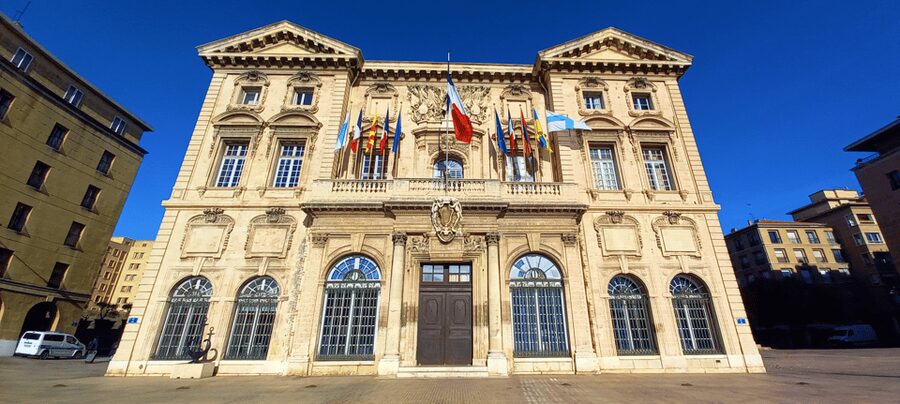
The climb ends at Notre-Dame de la Garde, Marseille’s hilltop basilica. The formal visit is listed at about five minutes, followed by a 25-minute break. In practical terms, this is your main pause and your best chance to catch your breath, take photographs, and enjoy the view.
The basilica is one of Marseille’s defining sights. From its high position, you can look across the city and out toward the sea. The view helps make sense of the route you have already walked: the port below, the dense old districts, the waterfront, and the hills that shape Marseille.
This stop is especially valuable because it gives you both context and rest. Charles can explain what you are seeing, while the break lets you take it in without being hurried from one point to the next.
Bring water. The Provençal sun can be strong, and the combination of heat, steps, and 9 kilometers can catch you out even if you normally walk a lot. Sunglasses, a hat, and sunscreen are specifically recommended.
Roucas Blanc and the city beyond the center
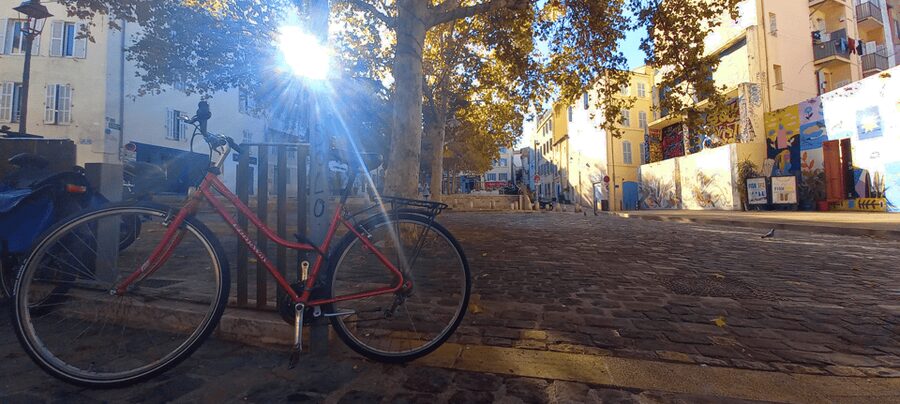
After Notre Dame de la Garde, you continue through Marseille for about 40 minutes. This part of the walk opens up the city beyond the oldest center and introduces the Roucas Blanc area.
The value here is comparison. You have already seen Le Panier’s narrow lanes and the Old Port’s urban center. Roucas Blanc gives you another side of Marseille, with a different feel and a closer relationship to the hills and sea.
Charles’s strength, based on the repeated praise he receives, is explaining how the city has changed from one district to another. He is not simply naming buildings. He connects neighborhoods with Marseille’s development, culture, and local way of life.
Some participants particularly valued his visits to back streets and a favorite pastry shop. The pastry stop is not guaranteed as a formal itinerary item, so think of it as the kind of local touch that may occur rather than a promised inclusion. Food and drinks are not included, and you should carry your own supplies.
Vallon des Auffes, a fishing port in a rocky cove
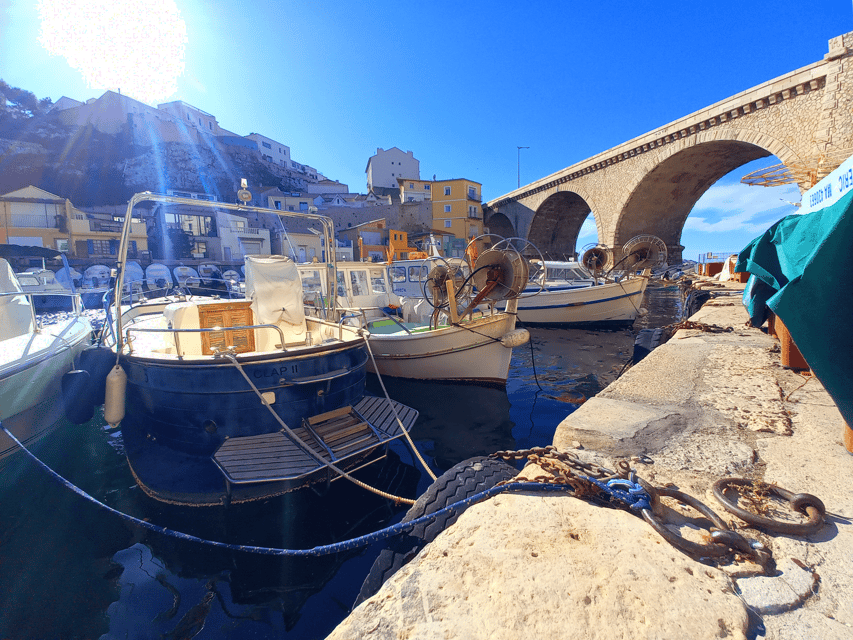
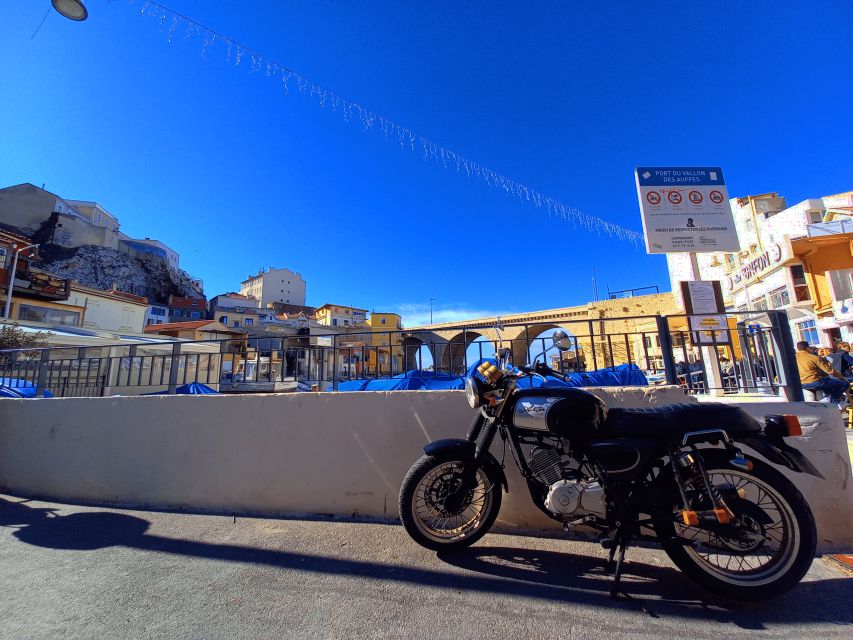
Vallon des Auffes is one of the route’s most memorable stops. This small fishing port sits in a rocky cove along the coast, and it feels quite different from the broad openness of the Old Port.
You have about 10 minutes here, enough for a guided look and photographs. The cove shows you a more intimate side of Marseille, with the sea pressed close to the houses and boats. It is the sort of place that is easy to miss if you stay only around the center.
The timing is short, so do not expect a long swim, meal, or independent exploration. You are still moving with the group. But as part of a larger route, Vallon des Auffes works beautifully: it gives the walk a strong visual change and a glimpse of Marseille’s coastal character.
Corniche Kennedy, Catalans Beach, and Palais du Pharo
The route then reaches the Monument aux morts de l’Armée d’Orient et des terres lointaines for a five-minute photo stop. From there, you walk along Corniche John Fitzgerald Kennedy for about 15 minutes.
The Corniche brings sea views into the tour in a direct way. You are no longer looking down at the water from the basilica. You are walking beside the coast, with the road, shore, and city forming a very different scene.
A brief stop at Plage des Catalans follows. The beach visit lasts around five minutes, so it is an orientation stop rather than beach time. If you want to swim or relax by the water, plan to return independently.
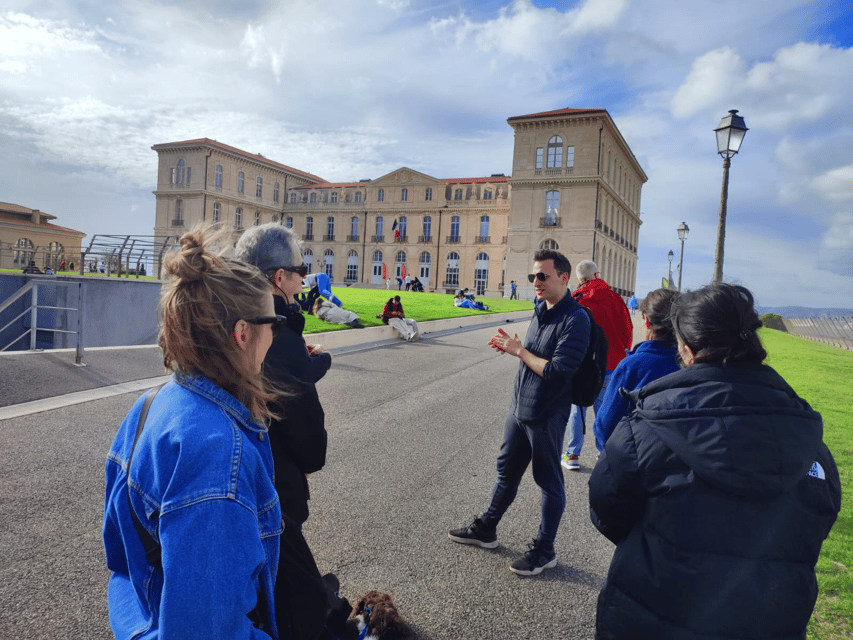
Palais du Pharo receives about 10 minutes. The building and its position above the harbor give you another strong viewpoint, and Charles adds context about Marseille’s civic and royal connections. The stop works best as part of the sequence: after the old quarter, harbor, hill, cove, and coast, you see how many different settings fit into one compact city.
Saint-Victor Abbey and the finish at the Old Port
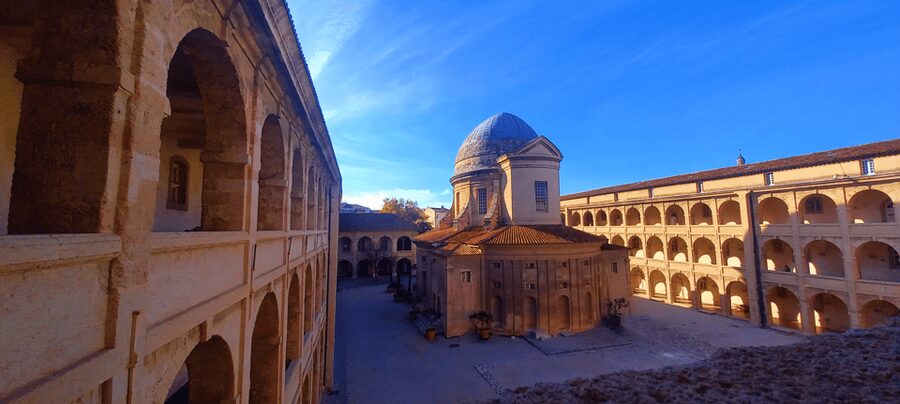
The final major stop is Saint Victor’s Abbey, where the guided sightseeing lasts roughly 20 minutes. This brings you back toward the historic core and gives the tour another religious and architectural landmark after La Major and Notre Dame de la Garde.
The finish is at the Old Port. This differs from the meeting point at La Major, so check your plans for the rest of the day. The two locations are close enough to fit naturally into a Marseille visit, but you should not assume you will finish exactly where you started.
By the end, you have crossed a wide slice of the city. You have seen historic quarters, major monuments, a park, a hilltop basilica, a fishing cove, a coastal road, a beach, and the harbor. That range is the main reason to choose this tour instead of a short central walking route.
Why Charles makes the difference
The route is ambitious, but the guide determines how enjoyable it feels. Charles is repeatedly praised for his passion, humor, clear explanations, and personal attention. He speaks English and French, and the small group lets him include questions and speak with people individually.
I particularly value the reports of him checking that everyone is comfortable and adapting the pace to the group. One family found the walk manageable even when a parent needed extra care on downhill sections. Another participant said Charles continued beyond four hours without complaint.
That does not make the walk easy. It means you are not treated like a number in a large crowd. With a maximum of eight people, you can ask questions, hear the answers, and form a friendly little group as the morning unfolds.
Charles also offers suggestions for places to eat and continue exploring. Those recommendations are useful at the end, when you have a better sense of the districts and can decide what deserves a second look.
Is $58 a fair price?
At $58 per person, this tour costs more than a basic self-guided walk, but it covers far more ground and includes a live bilingual guide, the Notre Dame de la Garde visit, and the short ferry ride.
The strongest value comes from the route design. You would need careful planning, local context, and a fair amount of map work to connect all these places on your own in four hours. You would also miss many of the stories and tucked-away streets that give the neighborhoods their character.
The price is easiest to justify if you have only a short stay, are visiting Marseille for the first time, or want a strong orientation before exploring alone. It is less appealing if you dislike fixed pacing, prefer long visits inside monuments, or want a relaxed half-day with little physical effort.
The rating is 5 out of 5 from 273 reviews, and the praise is unusually consistent around Charles rather than just the scenery. That is important. The sights are good, but the guide’s ability to link them into one story is what gives the tour its value.
Who should book this Marseille walk?
I would choose this for an active first morning in Marseille. It gives you a useful map in your head, introduces several districts, and leaves you with ideas for where to return.
It suits adults and older teenagers who can walk 9 kilometers and manage hills. It is not a good match for a slow sightseeing day, anyone with low fitness, or anyone who needs step-free access.
Book it early in your stay if possible. The walk’s broad route means Charles can help you decide what to revisit, where to eat, and which parts of Marseille deserve more time. Pack water, snacks, sunscreen, a hat, sunglasses, and proper walking shoes. Do not count on buying food during the route.
The tour allows free cancellation up to 24 hours before departure, and you can reserve now and pay later. Those terms add flexibility, but the bigger decision is physical: can you comfortably walk for four hours in sun, hills, and city streets?
Final verdict: a strong introduction for active visitors
I recommend this tour if you want to understand Marseille rather than simply photograph its Old Port. Charles brings warmth, humor, and local pride, while the route takes you from ancient quarters to coastal views and hilltop scenery.
Skip it if you want a short, flat walk or long independent stops. For everyone else, $58 buys a well-paced introduction to a complicated, fascinating city, with enough variety to make the exercise worthwhile.
FAQ
How long is the Marseille walking tour?
The tour lasts four hours and covers approximately 9 kilometers.
Where does the tour meet?
You meet in front of Cathédrale Basilique Sainte-Marie-Majeure, also called La Major. The guide wears a white cap.
Where does the tour finish?
The tour finishes at the Old Port of Marseille.
Which languages does the guide speak?
The live guide offers the tour in English and French.
How many people are in the group?
The group is limited to eight participants.
Is food or drink included?
No. You need to bring your own drinking water and food in your backpack.
What should I bring?
Bring sunglasses, a sun hat, sunscreen, hiking shoes, water, and food for the walk.
Is the tour suitable for people with limited mobility?
No. The tour is not suitable for wheelchair users or people with a low level of fitness. It includes 9 kilometers of walking, hills, and steps.
More Half-Day Plans in Marseille
- Marseille: City Highlights Guided Half-Day E-Bike Tour
★ 4.8 · 325 reviews - From Marseille: Cassis & Aix-en-Provence Half-Day Tour
★ 4.5 · 237 reviews - Marseille: Half-Day E-Bike Tour from Cruise Port
★ 4.7 · 201 reviews - Cassis: 3 Calanques Half-Day Hiking Tour with Swimming
★ 4.7 · 158 reviews
Recently added in Marseille
- The Urban Hike of Marseille★ 5.0 · 35 reviews
- Sunset Lavender Tour in Valensole with pickup from Marseille★ 5.0 · 41 reviews
- Sailing day in the heart of the Calanques★ 4.5 · 61 reviews
- Sormiou Calanques National Park Electric Bike Tour from Marseille★ 5.0 · 60 reviews
- Marseille Highlights & Wine Tasting Day Tour from Marseille★ 4.5 · 27 reviews
- Sightseeing Tour of Marseille with a Private Driver★ 4.5 · 26 reviews
- Rando-Palmée Getaway Around an island★ 4.0 · 54 reviews
- Cassis and Aix en Provence Sightseeing Tour from Marseille★ 4.5 · 132 reviews
Walking Tours, compared.

Paris Top Sights Half Day Walking Tour with a Fun Guide
Read our review →
Montmartre Hidden Gems and Scenic Highlights Walking Tour
Read our review →
Montmartre Hill French Gourmet Food and Wine Tasting Walking Tour
Read our review →
Paris Île de la Cité and Notre-Dame Walking Tour With Crypt
Read our review →
Montmartre Cheese, Wine & Pastry Guided Walking Tour
Read our review →
Paris in a Day: Louvre or Orsay, Eiffel Tower, City Walk & Cruise
Read our review →
Montmartre Highlights Walking Tour with a Local Guide
Read our review →
Paris City Center Free Walking Tour (Tip-Based)
Read our review →Browse the lists this tour appears in